


Role, Powers, and Functions of CBDT under Income-tax Act, 2025

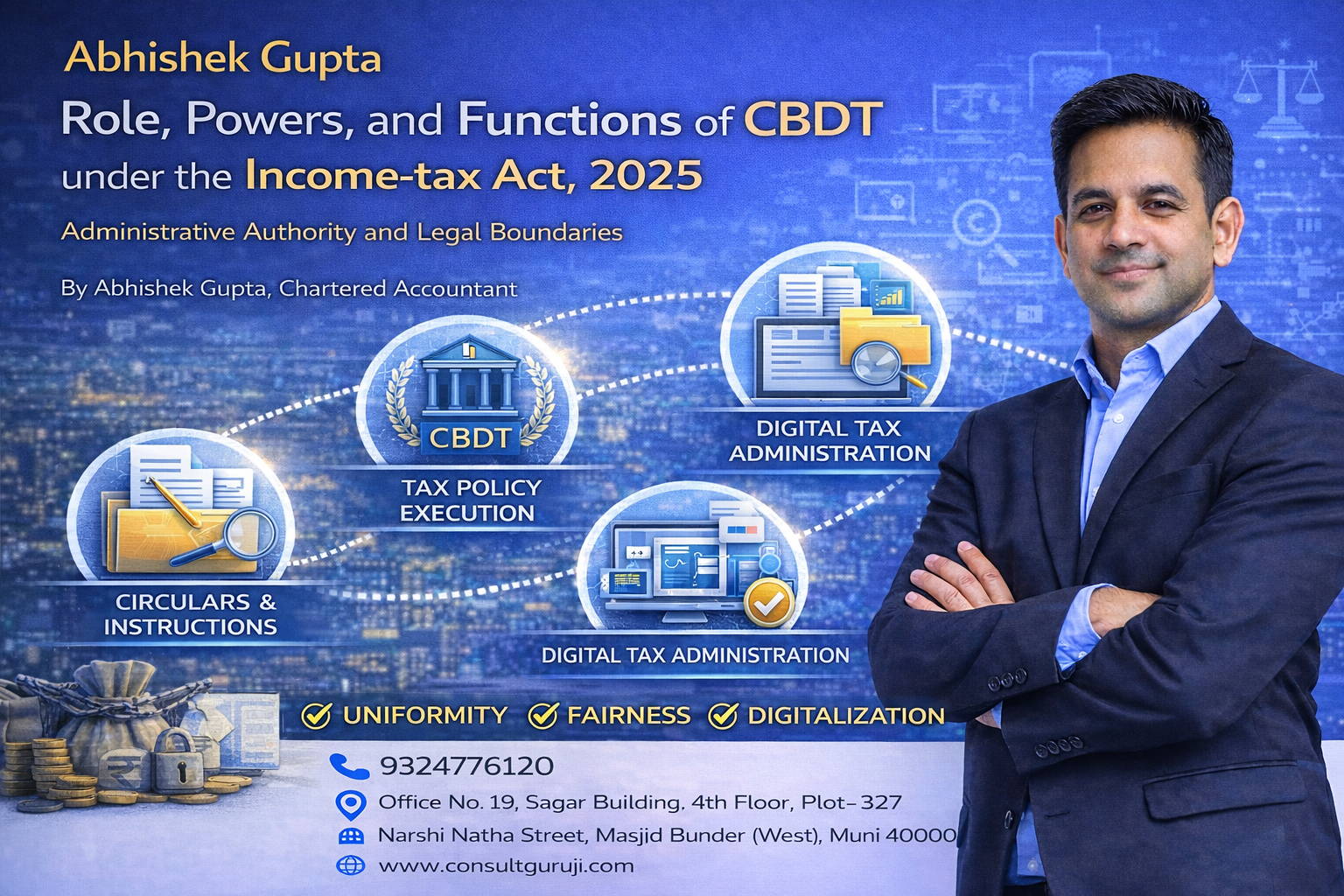
The Central Board of Direct Taxes (CBDT) is the apex administrative body responsible for implementing and administering India’s income-tax laws. Under the Income-tax Act, 2025, the role of CBDT has become even more significant due to increased digitisation, faceless proceedings, and data-driven enforcement.
Understanding the powers and limitations of CBDT is essential to appreciate how tax policy translates into day-to-day administration.
Position of CBDT under the Income-tax Framework
CBDT functions under the Ministry of Finance and acts as the policy-executing authority for direct taxes.
While Parliament enacts tax law, CBDT ensures:
Uniform application of law
Efficient administration
Procedural clarity
Coordination among tax authorities
CBDT does not make the law, but it operationalises it.
Statutory Powers of CBDT
Under the Income-tax Act, CBDT is empowered to:
Issue circulars and instructions
Prescribe procedures for assessments and appeals
Lay down administrative guidelines
Grant relaxations to mitigate genuine hardship
Standardise processes across jurisdictions
These powers ensure consistency and reduce arbitrary practices.
CBDT Circulars and Instructions
CBDT circulars play a crucial role in tax administration.
Key legal principles:
Circulars are binding on tax authorities
Beneficial circulars are binding even if inconsistent with strict interpretation
Adverse circulars cannot override statutory provisions
Courts have consistently held that CBDT circulars cannot impose tax where law does not.
Role in Faceless and Digital Tax Administration
CBDT is the architect of:
Faceless assessment framework
Faceless appeal mechanism
Centralised processing systems
Risk-based scrutiny selection
Through notifications and instructions, CBDT shapes how technology interacts with tax law.
Powers to Grant Relaxation and Amnesty
CBDT has discretionary powers to:
Extend deadlines
Waive penalties or interest in specified cases
Issue one-time relief schemes
Address systemic hardships
Such powers are exercised to balance revenue interest with fairness.
Limitations on CBDT’s Powers
CBDT’s authority is not absolute.
Important legal limits:
Cannot override the Income-tax Act
Cannot issue instructions contrary to judicial precedents
Cannot curtail taxpayer rights granted by statute
Cannot direct quasi-judicial authorities on merits of cases
Administrative convenience cannot trump statutory law.
CBDT and Judicial Oversight
Actions of CBDT are subject to:
High Court and Supreme Court review
Constitutional scrutiny
Principles of natural justice
This ensures accountability and prevents overreach.
Impact of CBDT on Taxpayers
CBDT decisions directly affect:
Compliance procedures
Filing timelines
Assessment practices
Litigation trends
A clear understanding of CBDT’s role helps taxpayers interpret departmental actions correctly.
Conclusion
Under the Income-tax Act, 2025, CBDT functions as the nerve centre of direct tax administration.
Its role is to:
Translate law into practice
Ensure consistency and efficiency
Facilitate digital transformation
Protect revenue without compromising fairness
CBDT is powerful, but bound by law.
Effective tax governance lies in this balance.
Written by:
Abhishek Gupta
Chartered Accountant
Office No. 19, Sagar Building, 4th Floor, Plot-327,
Narshi Natha Street, Masjid Bunder (West),
Mumbai – 400009
📞9324776120
🌐 www.consultguruji.com