


Validity of Notices Issued under Old Act after 2025

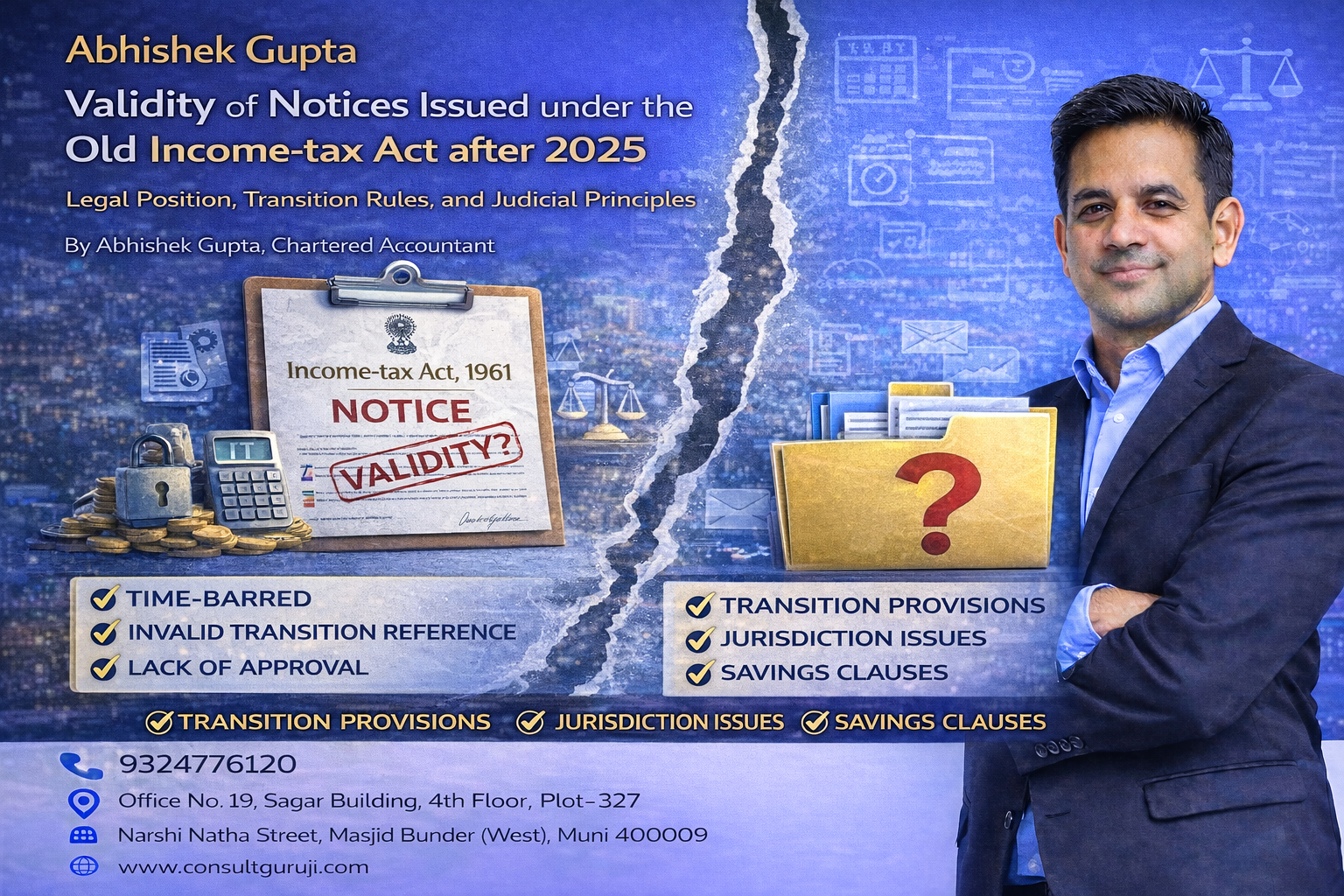
With the coming into force of the new Income-tax Act, 2025, one of the most contentious transition issues is the validity of notices issued under the Income-tax Act, 1961 after the new law becomes operative.
This question has serious implications for reassessment notices, scrutiny proceedings, penalties, and recovery actions. The answer lies in transition provisions, savings clauses, and settled judicial principles.
Core Issue: Do Old Act Notices Survive After 2025?
The repeal or replacement of a statute does not automatically invalidate actions lawfully taken under the old law, unless the new law expressly provides otherwise.
Accordingly, notices issued under the Income-tax Act, 1961 must be examined based on:
Date of issuance
Nature of proceedings
Stage of proceedings
Transition and saving provisions under the new Act
The law favours continuity, not disruption.
Role of Saving and Transition Provisions
The New Income-tax Act contains saving clauses to protect:
Actions already taken
Rights already accrued
Liabilities already incurred
Proceedings already initiated
Where a notice was:
Validly issued under the 1961 Act
Within limitation
By a competent authority
It does not become invalid merely because the new Act has come into force.
Substantive vs Procedural Law
A critical distinction governs validity:
Substantive Law
Charge of tax
Rate of tax
Penalty exposure
Conditions for reopening
These continue to be governed by the law applicable to the relevant assessment year.
Procedural Law
Mode of service
Faceless mechanism
Digital communication
Hearing process
Procedural provisions of the new Act may apply prospectively, if not prejudicial.
Courts consistently hold that procedural changes can apply to pending matters, but substantive changes cannot operate retrospectively.
Validity of Reassessment Notices
For reassessment notices issued under the old Act:
Jurisdiction must have been assumed correctly
Limitation under the 1961 Act must be satisfied
Mandatory pre-conditions (sanction, reasons, opportunity) must be complied with
If a notice suffers from:
Jurisdictional defect
Time-bar
Lack of approval
It can be challenged regardless of the new Act.
Transition cannot cure an illegal notice.
Notices Issued After 2025 Referring to Old Act
A serious legal issue arises where:
Notices are issued after 2025
Yet refer to repealed sections of the 1961 Act
Without backing from transition provisions
Such notices are vulnerable to challenge, unless expressly saved by law.
Courts have repeatedly held that:
Authority must act strictly within the law in force on the date of action.
Impact on Pending Scrutiny and Penalty Notices
Notices already issued and proceedings pending:
Continue under the old Act for substantive matters
May adopt new procedural framework if legally notified
Penalty proceedings:
Must follow penalty provisions applicable to the relevant year
Cannot be enhanced or altered by subsequent law
Taxpayer Remedies
Taxpayers may challenge invalid notices by:
Filing objections before the Assessing Officer
Raising jurisdictional grounds in appeal
Approaching High Courts through writ petitions
Seeking stay of proceedings where notice is prima facie invalid
Jurisdictional defects can be raised at any stage.
Common Grounds of Challenge
Invalidity challenges commonly arise due to:
Time-barred notices
Lack of mandatory approval
Mechanical sanction
Retrospective application of new law
Wrong section invocation
Transition is not a license for procedural shortcuts.
Conclusion
The validity of notices issued under the old Income-tax Act after 2025 depends on lawful initiation, correct jurisdiction, and proper saving provisions.
The new Act preserves legality, not illegality.
For taxpayers, vigilance during transition is essential.
For the department, strict adherence to transition law is mandatory.
A notice survives transition only if it survives the law.
Written by:
Abhishek Gupta
Chartered Accountant
Office No. 19, Sagar Building, 4th Floor, Plot-327,
Narshi Natha Street, Masjid Bunder (West),
Mumbai – 400009
📞9324776120
🌐 www.consultguruji.com