


Common Compliance Errors under Income-tax Act, 2025

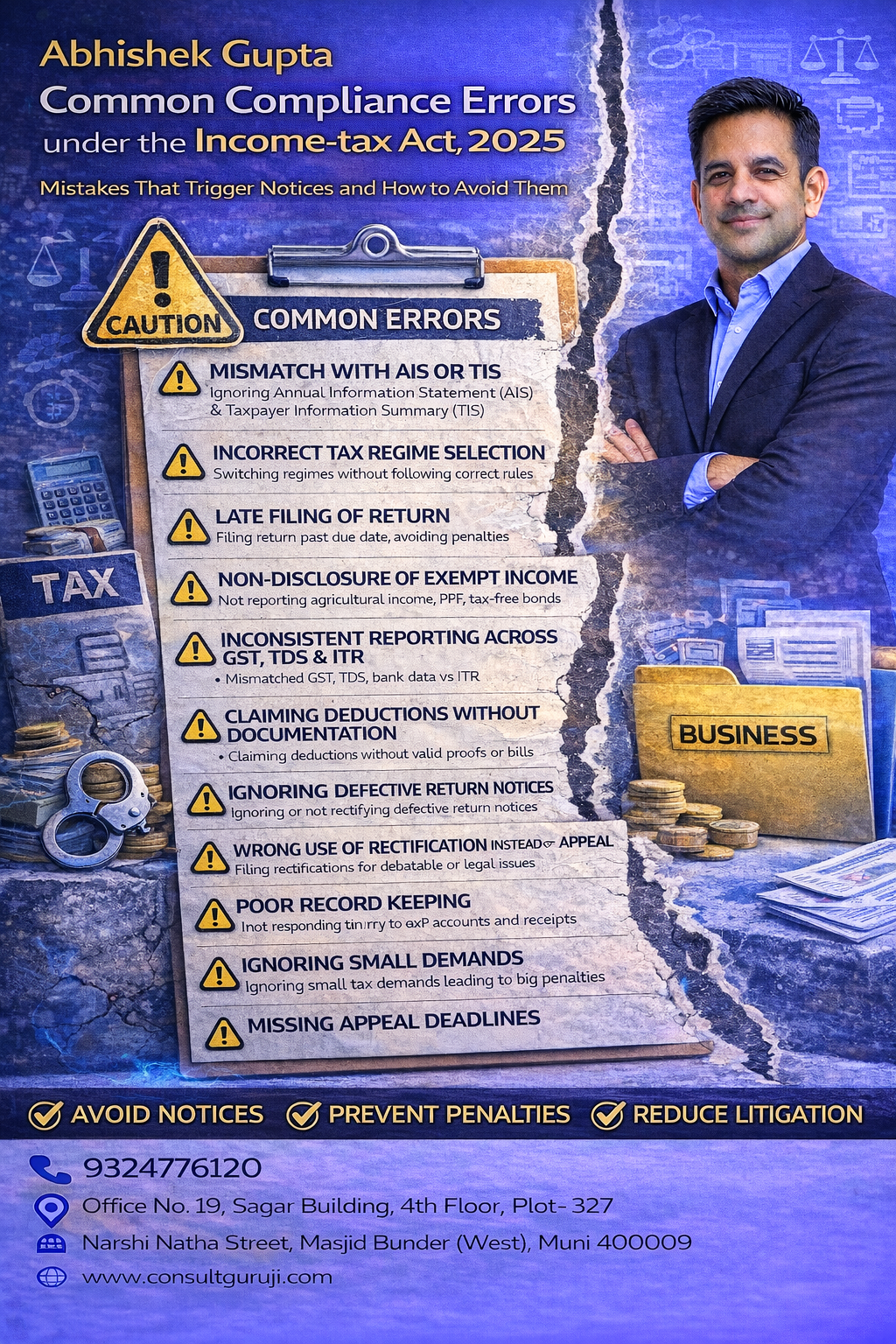
The Income-tax Act, 2025 has transformed tax compliance into a data-driven, system-monitored process. While the law itself is not harsher, tolerance for errors has reduced significantly.
Most tax disputes today arise not from tax evasion, but from avoidable compliance mistakes. Understanding these common errors is the first step towards staying notice-free.
1. Mismatch with AIS and TIS
One of the most frequent errors is filing the return without reconciling:
AIS (Annual Information Statement)
TIS (Taxpayer Information Summary)
Income reflected in AIS but not reported in the return almost automatically triggers scrutiny or adjustment.
Ignoring AIS is treated as acceptance of data.
2. Incorrect Tax Regime Selection
Many taxpayers select:
New tax regime but still claim old-regime deductions
Old regime without filing proper option
This results in:
Denial of deductions
Additional tax demand
Rectification or appeal burden
Tax regime selection must align with actual computation.
3. Late Filing of Return
Late filing under the 2025 Act leads to:
Mandatory late fees
Interest on tax payable
Loss of carry forward of losses
Restricted revision rights
Belated filing is no longer a harmless delay.
4. Non-Disclosure of Exempt Income
Taxpayers often assume exempt income need not be reported.
This is incorrect.
Exempt income like:
Agricultural income
PPF interest
Tax-free bonds
Dividend (where exempt)
must still be disclosed. Non-disclosure raises red flags.
5. Inconsistent Reporting Across GST, TDS, and ITR
For businesses, inconsistency between:
GST returns
TDS returns
Income-tax return
Bank statements
is a major compliance failure.
Cross-system mismatch is one of the strongest scrutiny triggers under the new Act.
6. Claiming Deductions Without Documentation
Deductions claimed without:
Proof of payment
Eligibility check
Supporting documents
are routinely disallowed during assessment.
In faceless proceedings, no document means no deduction.
7. Ignoring Defective Return Notices
Defective return notices are often ignored or responded casually.
Failure to rectify defects within time results in:
Return being treated as invalid
Loss of compliance status
Exposure to penalties
A defective return is a warning, not a suggestion.
8. Wrong Use of Rectification Instead of Appeal
Taxpayers frequently file rectification applications for:
Debatable issues
Legal disagreements
Disallowances requiring adjudication
Rectification is meant for apparent mistakes only.
Using it incorrectly leads to rejection and loss of time.
9. Non-Response or Delayed Response to Notices
Under faceless assessment, timelines are strict.
Non-response or delayed response results in:
Ex parte orders
Adverse additions
Increased litigation
Silence is treated as acceptance.
10. Poor Record Keeping
Inadequate maintenance of:
Books of accounts
Invoices
Bank statements
Capital gain workings
Loan records
weakens defence during assessment.
Digital compliance demands documentary discipline.
11. Ignoring Small Demands
Many taxpayers ignore small outstanding demands.
These demands:
Accumulate interest
Block refunds
Escalate into recovery proceedings
No demand is too small to ignore.
12. Missing Appeal Deadlines
Delay in filing appeal:
Makes order final
Eliminates legal remedy
Forces payment even if order is wrong
Limitation under tax law is unforgiving.
Conclusion
Under the Income-tax Act, 2025, most tax problems arise from compliance errors, not tax fraud.
Avoiding these common mistakes:
Reduces scrutiny risk
Protects refunds
Preserves appeal rights
Saves litigation cost
In a system-driven tax regime, accuracy and timeliness are the real tax planning tools.
Smart compliance today prevents painful disputes tomorrow.
Written by:
Abhishek Gupta
Chartered Accountant
Office No. 19, Sagar Building, 4th Floor, Plot-327,
Narshi Natha Street, Masjid Bunder (West),
Mumbai – 400009
📞9324776120
🌐 www.consultguruji.com