


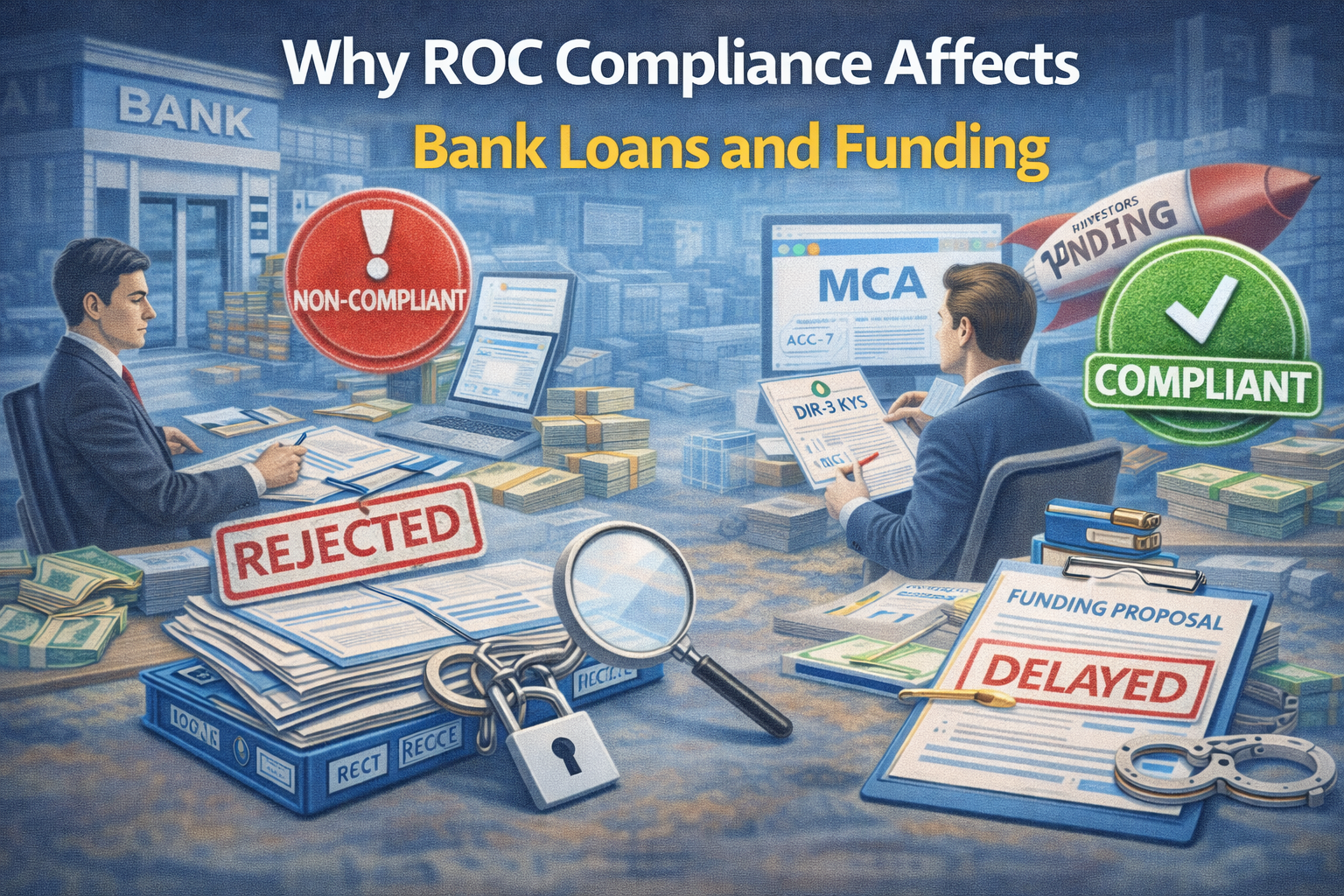
Why ROC compliance affects bank loans and funding

Introduction
Many businesses get rejected for bank loans or funding without understanding the real reason.
The problem is often not revenue, collateral, or projections.
It’s ROC non-compliance.
Before approving any loan or investment, banks and investors verify a company’s legal health. ROC records are the first checkpoint. If compliance is weak, funding stops immediately.
This blog explains how and why ROC compliance directly impacts bank loans and funding.
What Is ROC Compliance
ROC compliance means timely filing of statutory forms and disclosures with the Registrar of Companies under the Companies Act, 2013.
These filings include:
Annual returns (AOC-4, MGT-7 / MGT-7A)
Director compliances (DIR-3 KYC)
Share capital and allotment filings
Registered office updates
Together, these filings show whether a company is legally disciplined.
Why Banks and Investors Check ROC Records First
Banks and investors are not just lending money. They are managing risk.
ROC records help them verify:
Whether the company is active or non-compliant
Whether directors are eligible
Whether ownership and shareholding are clear
Whether past filings match current claims
If ROC data is wrong or missing, trust collapses.
How ROC Compliance Affects Bank Loans
1. Company Status on MCA Portal
Banks check whether the company status is:
Active
Active but non-compliant
Struck off
A non-compliant status can lead to:
Loan rejection
Delay in disbursement
Additional documentation demands
No bank wants exposure to a legally weak company.
2. Director Eligibility and DIN Status
If any director:
Has deactivated DIN
Missed DIR-3 KYC
Is disqualified
Banks may:
Reject the loan
Ask for director removal
Freeze processing
Directors are personally scrutinised.
3. Financial Statements Verification
Banks match:
Balance sheet figures
Paid-up capital
Borrowings
with:
AOC-4 filings on MCA
Mismatch between ROC records and financials is treated as a red flag.
4. Shareholding and Capital Structure Clarity
For funding and large loans, lenders verify:
Shareholding pattern
Recent share allotments
Authorised and paid-up capital
If ROC filings are missing or delayed:
Funding gets stalled
Valuation suffers
Due diligence fails
Ownership clarity is non-negotiable.
How ROC Compliance Affects Funding and Investment
Investors go deeper than banks.
They check:
Entire ROC filing history
Past defaults and penalties
Director track record across companies
Clean exit feasibility
Even one missed filing can:
Reduce valuation
Delay term sheet
Kill the deal during due diligence
Good compliance increases investor confidence instantly.
Common ROC Issues That Kill Loans and Funding
Non-filing of annual returns
DIR-3 KYC default of one director
Unreported share allotments
Incorrect registered office address
Past penalties and notices
Most of these issues are avoidable.
How Companies Can Stay Funding-Ready
Keep ROC filings up to date every year
Regularly check MCA portal status
Ensure director compliances are complete
Match financials with ROC data
Funding readiness starts with compliance hygiene.
Conclusion
ROC compliance is not a back-office formality.
It is a financial credibility tool.
Companies with clean ROC records:
Get loans faster
Raise funds easily
Face fewer questions
Command better valuation
Ignoring ROC compliance silently blocks growth.
Call to Action
If your company is planning to apply for a bank loan or raise funding, review and correct your ROC compliance first. It can be the difference between approval and rejection.
Written by:
Abhishek Gupta
Chartered Accountant
Office No. 19, Sagar Building, 4th Floor, Plot-327,
Narshi Natha Street, Masjid Bunder (West),
Mumbai – 400009
📞9324776120
🌐 www.consultguruji.com