


Continuation of Penalty and Prosecution Proceedings Post-2025

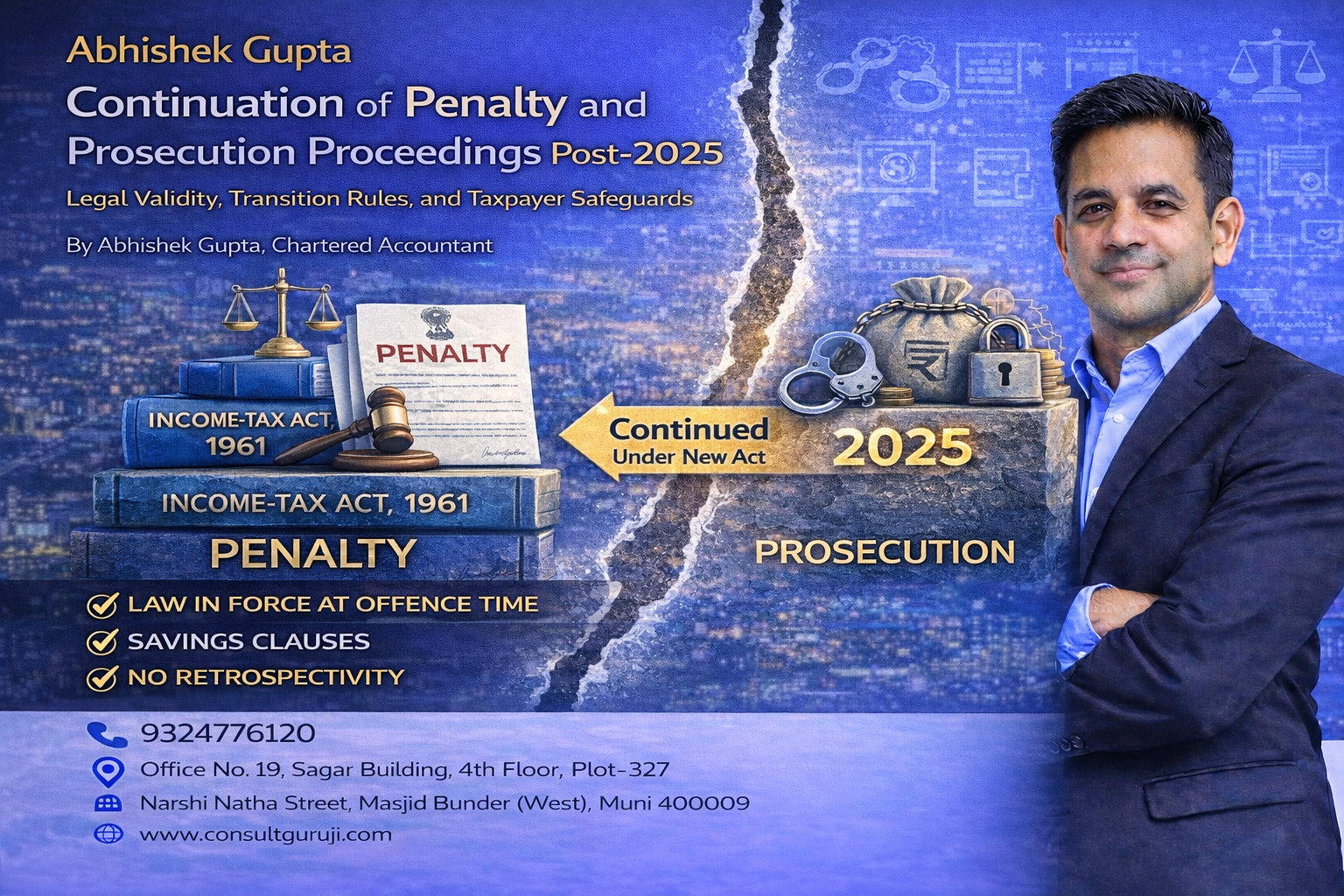
With the introduction of the Income-tax Act, 2025, a critical question arises for taxpayers already facing enforcement action: Do penalty and prosecution proceedings initiated under the Income-tax Act, 1961 continue after 2025?
The answer lies in transition provisions, saving clauses, and long-settled judicial principles. The new law aims at reform, not disruption. Accordingly, lawful proceedings do not collapse merely due to legislative change.
Nature of Penalty and Prosecution Proceedings
Penalty and prosecution proceedings are consequential proceedings. They arise from:
Assessment or reassessment orders
Findings of concealment, misreporting, or default
Statutory non-compliance under the law applicable to a specific assessment year
Their validity depends on the law in force during the relevant period, not the date of continuation.
Principle of Continuity after 2025
A fundamental rule of statutory transition is this:
Repeal or replacement of a statute does not extinguish liabilities already incurred, unless the new law expressly provides otherwise.
Accordingly:
Penalty proceedings validly initiated under the 1961 Act continue
Prosecution complaints lawfully filed do not abate
Pending penalty notices remain enforceable
The Income-tax Act, 2025 preserves this continuity through saving provisions.
Applicable Law for Penalty Proceedings
For penalties:
Substantive penalty provisions applicable to the assessment year continue to apply
Quantum, conditions, and defences are governed by the old Act
New penalty standards cannot be applied retrospectively
However:
Procedural aspects such as electronic communication, faceless mechanisms, or timelines may apply prospectively, if notified
Penalty exposure cannot be worsened by transition.
Continuation of Prosecution Proceedings
Prosecution proceedings are governed by:
Law in force at the time of alleged offence
Mens rea and offence definitions applicable for that year
Therefore:
Prosecution initiated under the 1961 Act continues under that framework
New Act cannot retrospectively create or enhance criminal liability
Sanction defects, limitation, or lack of jurisdiction remain valid grounds of defence
Criminal liability is strictly construed.
Common Misconceptions Clarified
Many taxpayers assume:
New Act means fresh start
Old penalties automatically lapse
Prosecutions become invalid
All three assumptions are incorrect.
What matters is lawful initiation, not nomenclature of the statute.
Safeguards Available to Taxpayers
Even post-2025, taxpayers retain strong protections:
Penalty cannot survive if assessment is set aside
Prosecution cannot continue if foundational addition fails
Retrospective application of harsher provisions is prohibited
Jurisdictional and procedural defects can be challenged at any stage
Transition law does not dilute constitutional protections.
Interplay with Appeals and Litigation
Where:
Quantum appeal is pending
Additions are under challenge
Stay of demand is granted
Penalty and prosecution proceedings may be:
Kept in abeyance
Challenged as premature
Stayed by appellate or constitutional courts
Proceedings must follow outcome of substantive dispute.
Key Areas of Litigation Post-2025
Disputes commonly arise on:
Whether proceedings were “validly initiated”
Application of new procedural rules
Time limitation under old vs new law
Mechanical continuation without satisfaction recording
These issues will shape early judicial interpretation of the 2025 transition.
Conclusion
The Income-tax Act, 2025 does not wipe the slate clean. It carries forward lawful penalty and prosecution proceedings, while preserving taxpayer rights and legal defences.
Continuity protects revenue.
Judicial safeguards protect taxpayers.
For taxpayers facing enforcement action, the focus should be clear:
Identify applicable law
Separate substance from procedure
Challenge illegality, not continuity
A proceeding survives transition only if it survives the law.
Written by:
Abhishek Gupta
Chartered Accountant
Office No. 19, Sagar Building, 4th Floor, Plot-327,
Narshi Natha Street, Masjid Bunder (West),
Mumbai – 400009
📞9324776120
🌐 www.consultguruji.com