


Electronic Records and Digital Evidence under New Act

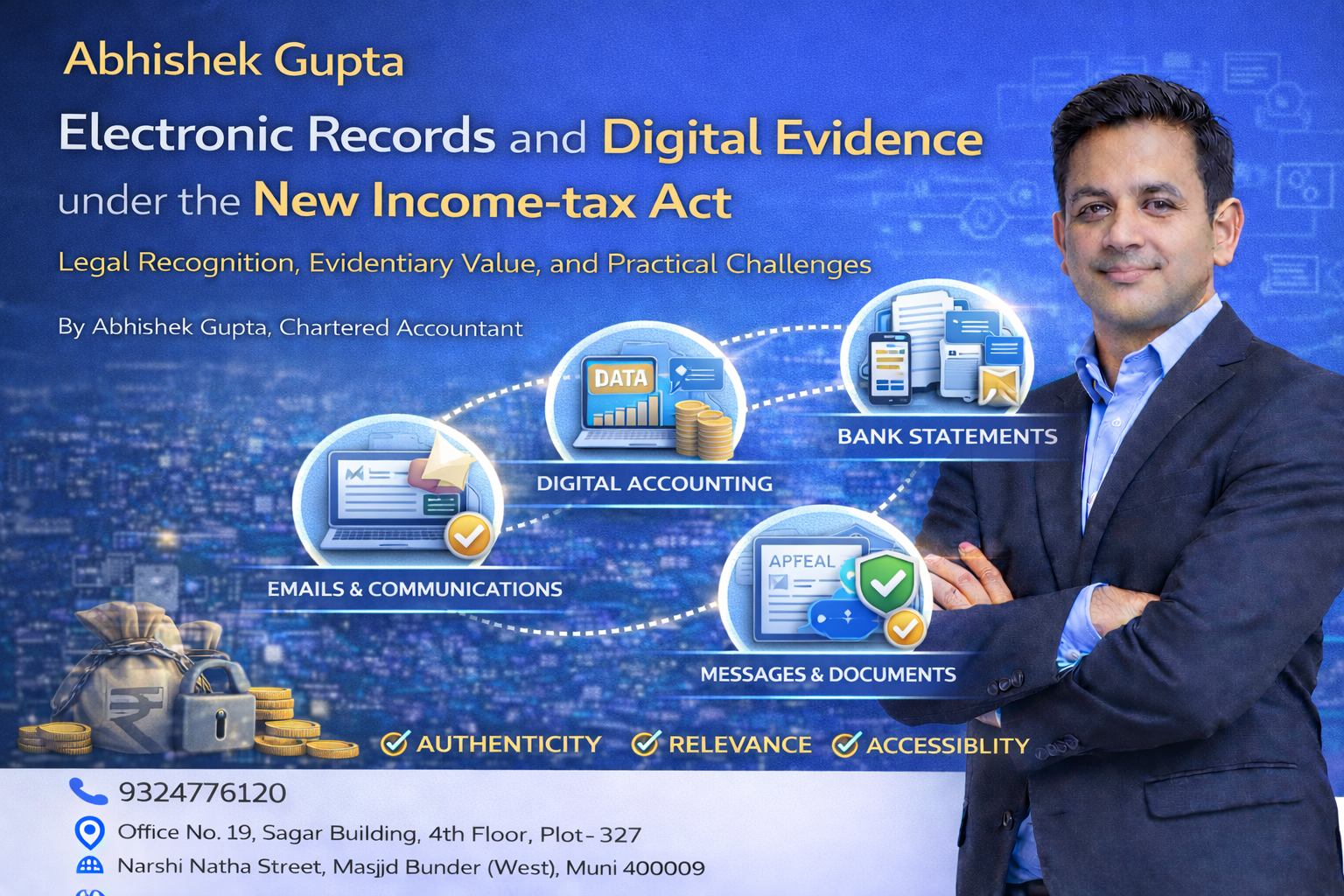
Tax administration has decisively moved into the digital era. Under the New Income-tax Act, electronic records and digital evidence are no longer supplementary. They are now central to assessments, reassessments, surveys, searches, and appellate proceedings.
Understanding how digital evidence is recognised, evaluated, and challenged has become essential for every taxpayer and tax professional.
Meaning of Electronic Records and Digital Evidence
Electronic records include any information generated, received, stored, or transmitted in electronic form.
This covers:
Emails and electronic communications
Digital accounting records
Bank statements and transaction logs
Cloud-stored documents
WhatsApp messages and SMS (where relevant)
System-generated reports and analytics
Under the New Act, such records have explicit legal recognition.
Legal Recognition under the New Framework
The New Income-tax Act aligns tax proceedings with modern evidentiary standards.
Electronic records:
Are admissible as evidence
Can form the basis of additions and disallowances
Are routinely relied upon in faceless assessments
However, admissibility does not automatically mean conclusive proof.
Evidentiary Value of Digital Evidence
Digital evidence must satisfy:
Authenticity
Integrity
Relevance
Proper linkage with the taxpayer
Courts have consistently held that:
Raw digital data without verification has limited value
Electronic records must be corroborated with surrounding facts
Context matters more than isolated extracts
Data without explanation is not evidence.
Evidence requires interpretation.
Use of Digital Evidence in Assessment Proceedings
Assessing Officers increasingly rely on:
AIS and TIS data
Bank transaction analytics
Digital trails from GST and financial platforms
Electronic confirmations and statements
While such data strengthens detection, mechanical reliance without verification violates natural justice.
Taxpayers must be given:
Opportunity to explain
Access to relied-upon material
Time to rebut digital findings
Electronic Evidence in Search and Survey
During search and survey proceedings, authorities may:
Access digital storage devices
Copy electronic records
Examine cloud-based data
However:
Unrelated personal data cannot be used indiscriminately
Digital evidence must relate to undisclosed income
Additions must be based on incriminating material, not volume of data
Digital fishing expeditions do not survive appellate scrutiny.
Challenges and Risks for Taxpayers
Common risks arising from digital evidence include:
Misinterpretation of emails or chats
Incomplete data extraction
Out-of-context reliance on messages
Automated mismatch flags without human review
Digital evidence amplifies errors when not properly analysed.
Taxpayer Rights in Relation to Digital Evidence
Taxpayers have the right to:
Inspect electronic material relied upon
Seek copies of digital evidence
Challenge authenticity and relevance
Cross-verify system-generated data
Rebut digital conclusions with explanations and documents
Technology cannot override constitutional fairness.
Best Practices for Taxpayers and Professionals
To manage digital evidence effectively:
Maintain clean digital records
Ensure consistency across systems
Document explanations contemporaneously
Avoid informal business communication channels
Respond precisely to digital allegations
In a digital tax system, your data speaks before you do.
Conclusion
Under the New Income-tax Act, electronic records and digital evidence have transformed tax enforcement.
They enhance transparency and efficiency, but also demand:
Higher compliance discipline
Better documentation
Stronger legal understanding
Digital evidence is powerful, but only lawful, contextual, and corroborated data survives judicial scrutiny.
Technology strengthens the law.
It does not replace it.
Written by:
Abhishek Gupta
Chartered Accountant
Office No. 19, Sagar Building, 4th Floor, Plot-327,
Narshi Natha Street, Masjid Bunder (West),
Mumbai – 400009
📞9324776120
🌐 www.consultguruji.com