


Faceless Appeal System: Legal Validity and Procedure

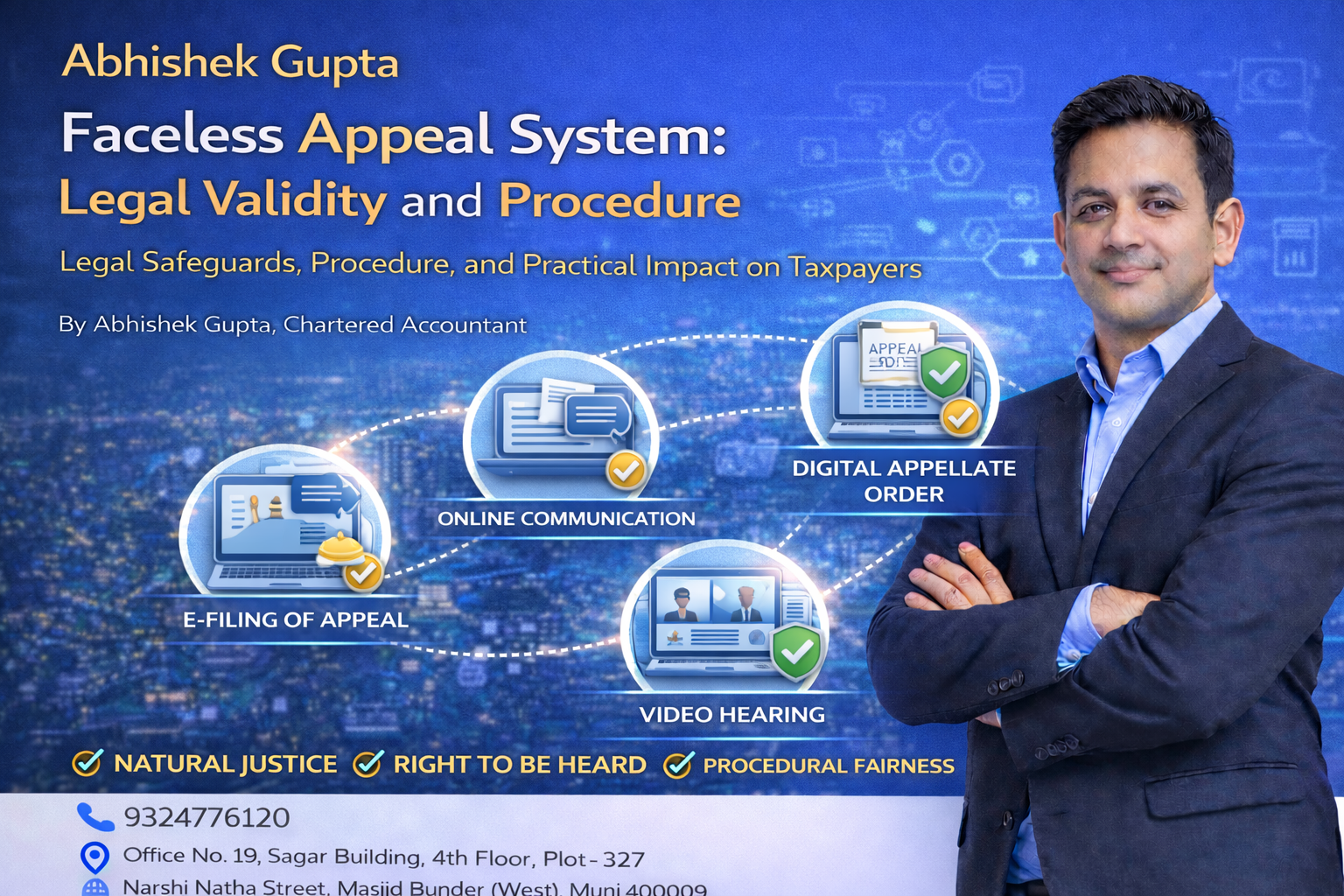
The Faceless Appeal System marks a major transformation in India’s tax dispute resolution framework. Introduced to enhance transparency and eliminate personal interface, the system fundamentally changes how appeals before the first appellate authority are conducted.
Under the Income-tax Act, 2025, faceless appeals are no longer transitional. They are an integral part of the appellate mechanism, subject to legal safeguards and judicial scrutiny.
Concept of Faceless Appeal
The faceless appeal system replaces traditional physical hearings with a technology-driven process where:
Appeals are allocated electronically
Communication takes place exclusively through the income-tax portal
Appellate officers remain anonymous
Hearings, where granted, are conducted via video conferencing
The objective is to ensure neutral, unbiased, and standardised appellate decisions.
Legal Validity of the Faceless Appeal System
The faceless appeal framework derives its authority directly from the Income-tax Act and the rules notified thereunder.
Courts have upheld its validity on the condition that:
Principles of natural justice are followed
Adequate opportunity of hearing is granted
Orders are reasoned and speaking
Procedural fairness is not compromised by automation
Faceless does not mean discretion-less. It means process-driven adjudication.
Procedure under the Faceless Appeal System
The appellate process broadly involves:
Electronic filing of appeal
Submission of written grounds and statements
Upload of documentary evidence
Exchange of notices and replies online
Optional video conference hearing
Passing of digital appellate order
Each stage is time-bound and system-tracked.
Right to Personal Hearing
A key safeguard under the faceless appeal system is the right to seek a personal hearing through video conferencing.
If complex factual or legal issues are involved, denial of hearing without reasons can invalidate the appellate order.
Judicial forums have consistently held that effective hearing is a substantive right, not a formality.
Challenges in Faceless Appeals
Despite its objectives, faceless appeals face practical challenges:
Mechanical disposal of appeals
Over-reliance on written submissions
Limited appreciation of business realities
Inadequate consideration of evidence
These issues have led to increased scrutiny by higher appellate authorities.
Impact on Tax Litigation
In the long run, faceless appeals are expected to:
Reduce subjectivity in appellate decisions
Improve consistency across jurisdictions
Lower interpersonal disputes
However, improper implementation may result in:
Increased ITAT litigation
Higher writ petitions on natural justice grounds
Quality of adjudication remains the decisive factor.
Taxpayer Responsibilities
Under faceless appeals, taxpayers must:
Draft precise and structured submissions
Upload complete evidence
Monitor portal communications closely
Respond within strict timelines
There is no scope for oral persuasion beyond written clarity.
Conclusion
The Faceless Appeal System is legally valid and constitutionally sound when implemented with fairness and procedural discipline.
It represents a shift from personality-driven justice to process-driven justice.
For taxpayers, success depends on preparation, documentation, and digital vigilance.
Faceless appeal is not weaker appeal.
It is a different appeal, demanding higher precision
Written by:
Abhishek Gupta
Chartered Accountant
Office No. 19, Sagar Building, 4th Floor, Plot-327,
Narshi Natha Street, Masjid Bunder (West),
Mumbai – 400009
📞9324776120
🌐 www.consultguruji.com