


Importance of AOC-4 filing and its impact on directors

Introduction
Many directors think AOC-4 is just another ROC form handled by the accountant.
That assumption is dangerous.
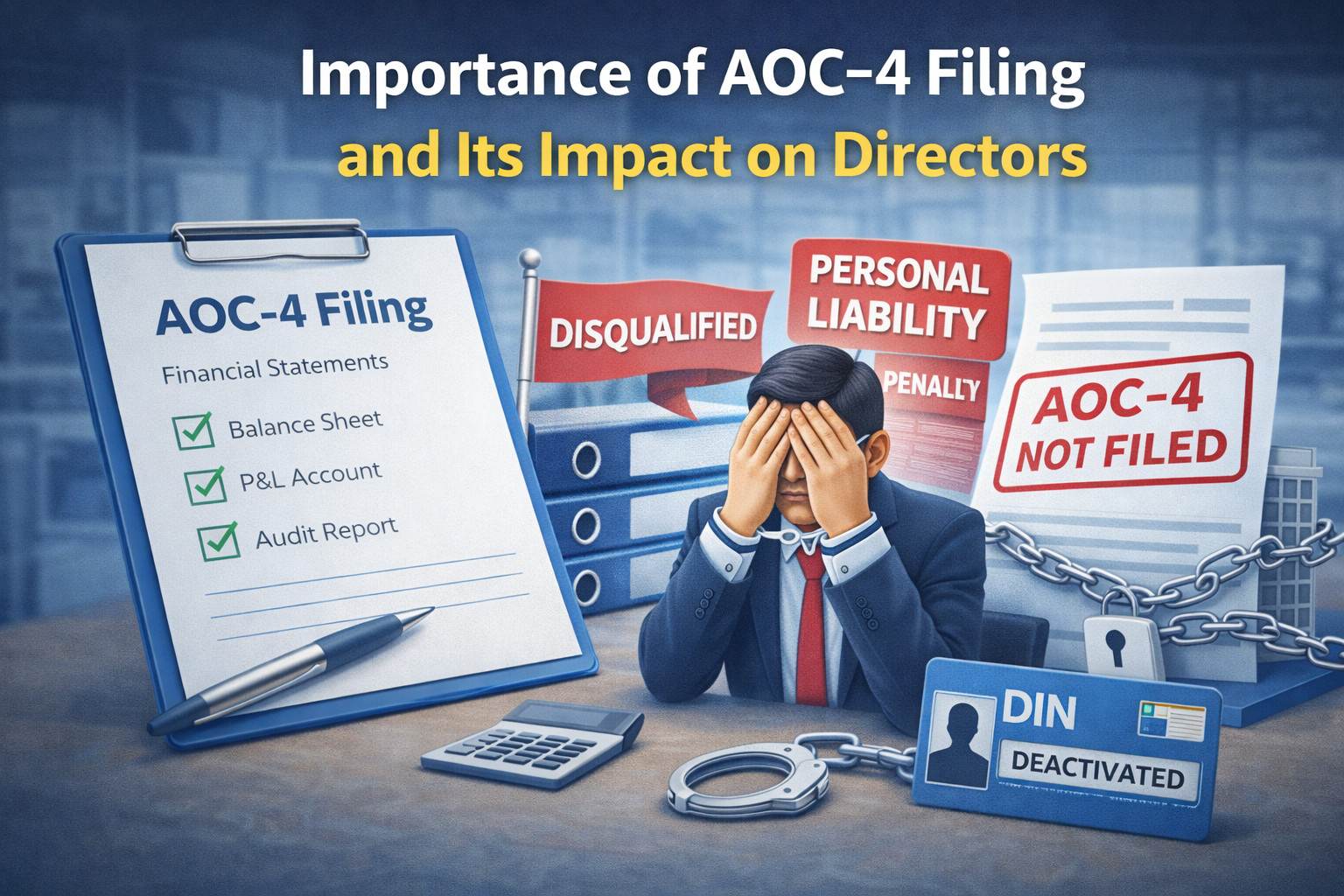
AOC-4 filing directly affects directors’ legal standing, penalties, and even future business eligibility.
This blog explains why AOC-4 is important and how non-filing impacts directors personally.
What Is AOC-4
AOC-4 is the form used to file a company’s financial statements with the Registrar of Companies under the Companies Act, 2013.
It includes:
Balance Sheet
Profit & Loss Account
Auditor’s Report
Notes to Accounts
This filing confirms the company’s financial position to the government.
Why AOC-4 Filing Is Mandatory
Every company must file AOC-4 within 30 days of the Annual General Meeting (AGM).
Even if:
There is no profit
There is minimal activity
The company is inactive
AOC-4 filing remains compulsory.
What this really means is simple:
No AGM filing = no legal compliance.
Importance of AOC-4 Filing
1. Confirms Financial Transparency
AOC-4 ensures that the company’s financials are:
Audited (where required)
Transparent
Available for government verification
This protects both the company and its directors.
2. Mandatory for Completing Annual ROC Compliance
AOC-4 is the first step of annual ROC compliance.
Without AOC-4:
MGT-7 / MGT-7A becomes incomplete
Annual compliance remains defective
Incomplete compliance creates legal exposure.
3. Essential for Bank Loans and Due Diligence
Banks, investors, and regulators check AOC-4 filings during:
Loan processing
Funding rounds
Company valuation
Missing filings raise immediate red flags.
Impact of Non-Filing of AOC-4 on Directors
1. Heavy Late Fees
Late fees for AOC-4 are charged per day, often without a maximum cap.
Delays of years can lead to:
Huge financial burden
Difficulty in clearing past defaults
2. Director Disqualification Risk
If AOC-4 is not filed for three consecutive years, directors face:
Disqualification under company law
Ban from holding directorships
MCA portal flagging
This impacts all companies where the director is involved.
3. Legal Notices and Prosecution
ROC may issue:
Show cause notices
Penalty orders
Prosecution in serious cases
Directors are personally answerable.
4. Problems in DIN and KYC Compliance
Non-filing leads to:
DIN related restrictions
DIR-3 KYC issues
Difficulty signing future ROC forms
Common Reasons Companies Miss AOC-4
Delay in finalisation of accounts
Assumption of nil activity exemption
Auditor issues
Ignoring AGM timelines
None of these reasons are accepted as legal excuses.
How Directors Can Stay Safe
Ensure AGM is conducted on time
Finalise accounts early
Track AOC-4 due dates personally
Verify filing status on MCA portal
Delegation is fine, responsibility is not transferable.
Conclusion
AOC-4 is not just a compliance form.
It is a director-level legal responsibility.
Timely AOC-4 filing:
Protects directors
Avoids penalties
Keeps the company compliant and credible
Ignoring it creates long-term legal damage.
Call to Action
If your company has missed AOC-4 filing for any year, immediate corrective action is critical to protect directors from penalties and disqualification.
Written by:
Abhishek Gupta
Chartered Accountant
Office No. 19, Sagar Building, 4th Floor, Plot-327,
Narshi Natha Street, Masjid Bunder (West),
Mumbai – 400009
📞9324776120
🌐 www.consultguruji.com