


Importance of ROC compliance for GST, Income Tax, and MCA checks

Introduction
Many businesses treat ROC, GST, and Income Tax as separate compliances handled by different people.
That thinking is outdated.
Today, GST, Income Tax, and MCA systems are interconnected.
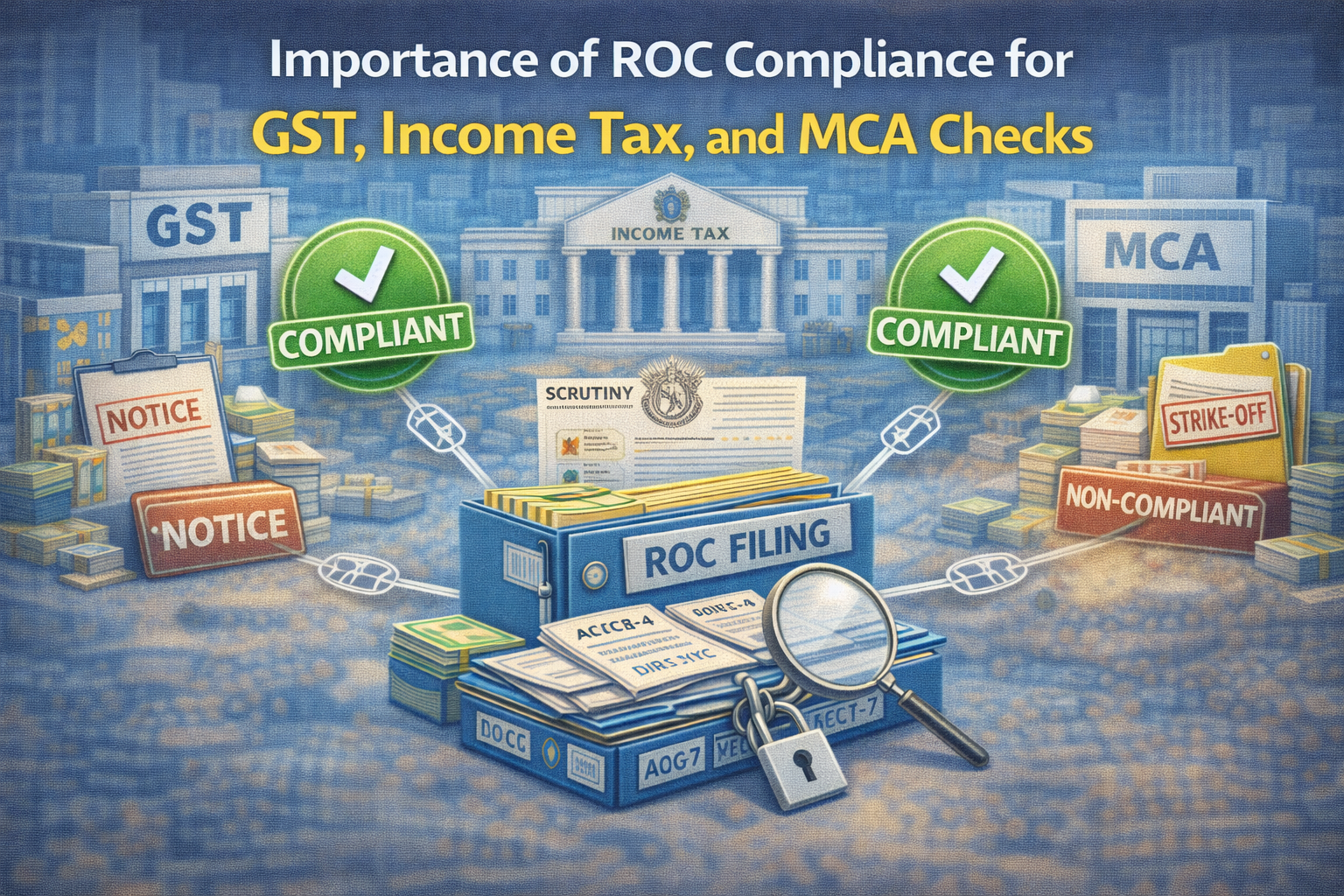
If ROC compliance is weak, it directly triggers red flags during GST scrutiny, Income Tax assessment, and MCA verification.
This blog explains why ROC compliance is critical to pass GST, Income Tax, and MCA checks smoothly.
What Is ROC Compliance
ROC compliance means filing statutory returns and disclosures with the Registrar of Companies under the Companies Act, 2013.
Key ROC filings include:
Annual filings (AOC-4, MGT-7 / MGT-7A)
Director compliances (DIR-3 KYC)
Share capital and allotment filings
Registered office updates
Director appointment and resignation filings
These filings define the official legal profile of a company.
How ROC Data Is Used by GST, Income Tax, and MCA
Government departments do not work in silos anymore.
They cross-check:
Company status
Director details
Financial data
Address and ownership records
ROC records form the base reference for all other departments.
Importance of ROC Compliance for GST Checks
GST authorities verify:
Company status on MCA
Registered office address
Director details
Turnover consistency
If ROC records show:
Inactive company
Incorrect address
Director non-compliance
GST may trigger:
Registration suspension
Notice under GST Act
Difficulty in amendments and refunds
ROC non-compliance often leads to GST trouble.
Importance of ROC Compliance for Income Tax Checks
Income Tax department cross-verifies:
Financial statements filed in AOC-4
Paid-up capital and reserves
Director details and DIN status
Mismatch between:
ITR
Balance sheet
ROC filings
can lead to:
Scrutiny notices
Additions and disallowances
Allegations of bogus entities or shell companies
Clean ROC filings strengthen Income Tax defence.
Importance of ROC Compliance for MCA Verification
MCA continuously monitors:
Filing defaults
Director eligibility
Company activity status
Non-compliance results in:
Company marked as non-compliant
Director disqualification risk
Strike-off proceedings
Once MCA flags a company, other departments follow.
Why ROC Compliance Acts as a Shield
Proper ROC compliance:
Proves company is genuine
Confirms directors are legitimate
Establishes financial transparency
Reduces suspicion during audits
In simple words, ROC compliance builds credibility across departments.
Common Problems Caused by ROC Non-Compliance
GST notices due to address mismatch
Income Tax scrutiny due to balance sheet mismatch
MCA penalties and disqualification
Difficulty in bank KYC and compliance
Most of these start from ignored ROC filings.
How to Stay Safe Across All Departments
File ROC returns on time every year
Ensure financials match GST and ITR data
Keep director compliances updated
Periodically review MCA portal status
Strong ROC compliance simplifies all other compliances.
Conclusion
ROC compliance is not limited to company law.
It directly impacts GST, Income Tax, and MCA checks.
Companies with clean ROC records:
Face fewer notices
Handle scrutiny confidently
Avoid inter-departmental issues
Ignoring ROC compliance invites trouble from all sides.
Call to Action
If your company is facing GST, Income Tax, or MCA issues, review your ROC compliance first. In many cases, fixing ROC filings solves multiple problems at once.
Written by:
Abhishek Gupta
Chartered Accountant
Office No. 19, Sagar Building, 4th Floor, Plot-327,
Narshi Natha Street, Masjid Bunder (West),
Mumbai – 400009
📞9324776120
🌐 www.consultguruji.com