

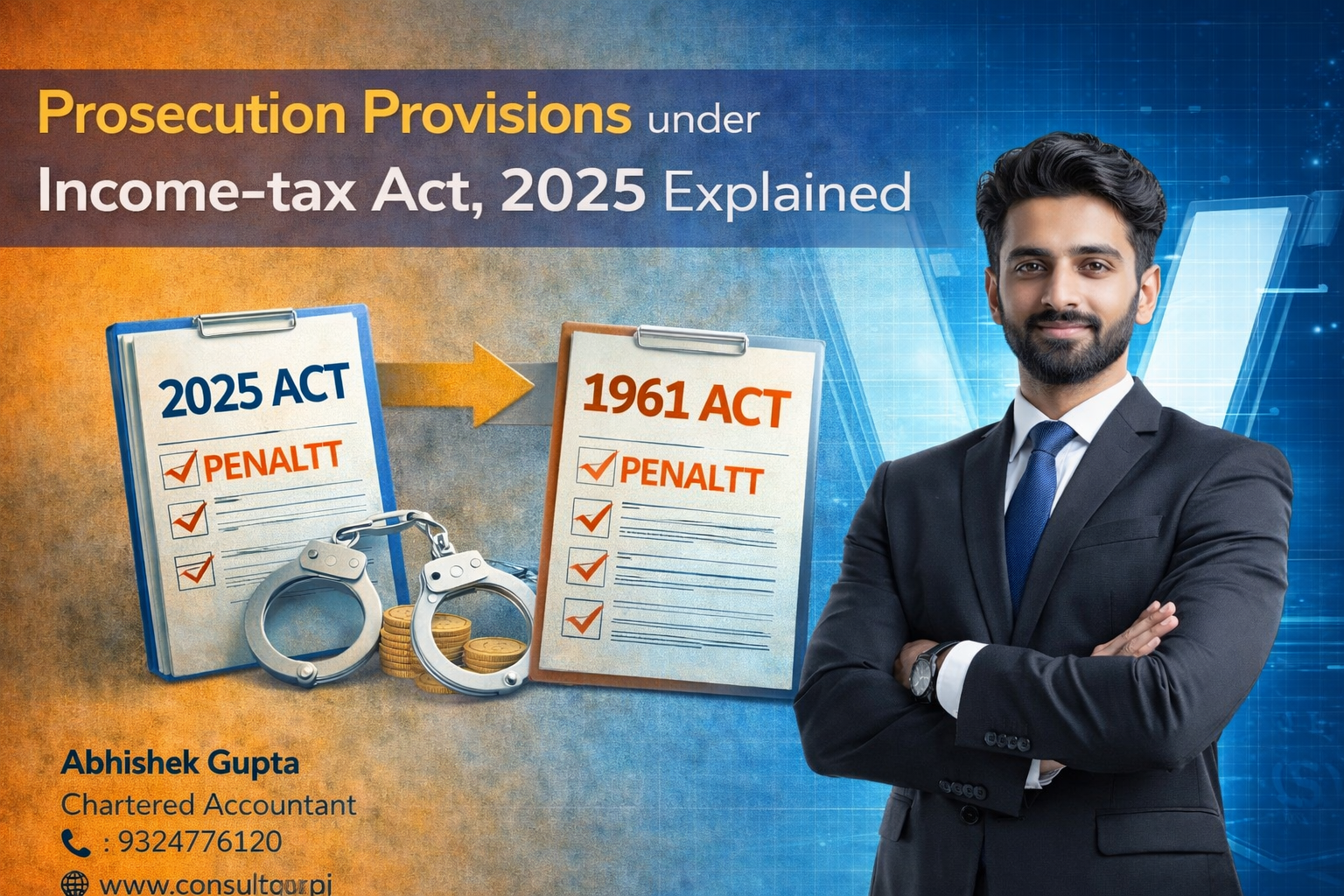
Prosecution Provisions under Income-tax Act, 2025 Explained

Introduction
The Income-tax Act, 2025 introduces a reorganised and streamlined framework for prosecution provisions. While the core objective of penalising serious tax offences remains unchanged, the new Act restructures sections, simplifies language, and improves clarity for taxpayers and professionals.
This blog explains how prosecution provisions have been structurally reorganised under the Income-tax Act, 2025 compared to the Income-tax Act, 1961.
What Are Prosecution Provisions?
Prosecution provisions deal with criminal proceedings initiated by the Income Tax Department for serious defaults such as:
Wilful tax evasion
Failure to file returns
Non-payment of TDS/TCS
False verification or falsification of accounts
These provisions go beyond monetary penalties and may result in imprisonment and fines.
Structure under Income-tax Act, 1961
Under the 1961 Act:
Prosecution sections were scattered across different chapters
Multiple amendments over decades made interpretation complex
Overlapping provisions often caused litigation
Procedural clarity was limited
Reorganisation under Income-tax Act, 2025
The 2025 Act focuses on structural clarity by:
Grouping prosecution-related provisions logically
Using simpler and consistent terminology
Clearly distinguishing between technical defaults and serious offences
Aligning prosecution triggers with modern compliance systems
The intent is to reduce unnecessary prosecutions while ensuring strict action against deliberate tax evasion.
Key Structural Changes
Better sequencing of prosecution sections
Clear linkage between default, intent, and punishment
Improved harmony with penalty and compounding provisions
Reduced scope for discretionary misuse
Impact on Taxpayers and Professionals
Genuine taxpayers get better protection
Reduced fear of prosecution for procedural lapses
Easier advisory and compliance for professionals
Faster and more predictable enforcement
Conclusion
The prosecution framework under the Income-tax Act, 2025 reflects a shift towards clarity, fairness, and proportional enforcement. While strict action continues for serious offences, the reorganised structure ensures that prosecution is used as a last resort rather than a routine compliance tool.
Understanding these changes is essential for taxpayers, businesses, and professionals operating under the new law.
Written by:
Abhishek Gupta
Chartered Accountant
Office No. 19, Sagar Building, 4th Floor, Plot-327
Narshi Natha Street, Masjid Bunder (West),
Mumbai – 400009
📞 9324776120
🌐 www.consultguruji.com