

Penalty Provisions: Income-tax Act 2025 vs 1961


Introduction
Penalty provisions play a critical role in ensuring tax compliance. Over the years, frequent amendments under the Income-tax Act, 1961 made penalty-related sections complex and litigation-prone.
The Income-tax Act, 2025 restructures these provisions with clearer sectioning, simplified language, and reduced ambiguity—while retaining the same legislative intent.
This article explains how penalty provisions have been reorganised in the new Act and how they compare with the old law.
Penalty Framework under Income-tax Act, 1961
Under the 1961 Act, penalty provisions were spread across multiple sections such as:
Penalty for concealment or furnishing inaccurate particulars
Penalties for failure to comply with notices
Penalties linked with TDS/TCS defaults
Discretion-based penalties leading to inconsistent interpretations
These scattered provisions often resulted in overlapping penalties and higher litigation.
Reorganisation of Penalty Provisions in Income-tax Act, 2025
The 2025 Act introduces a streamlined and structured penalty framework, focusing on:
Logical grouping of penalty sections
Clear distinction between procedural defaults and substantive defaults
Reduced discretionary power
Alignment with faceless and technology-driven assessments
The objective is certainty, transparency, and fairness.
Key Changes: Old Act vs New Act
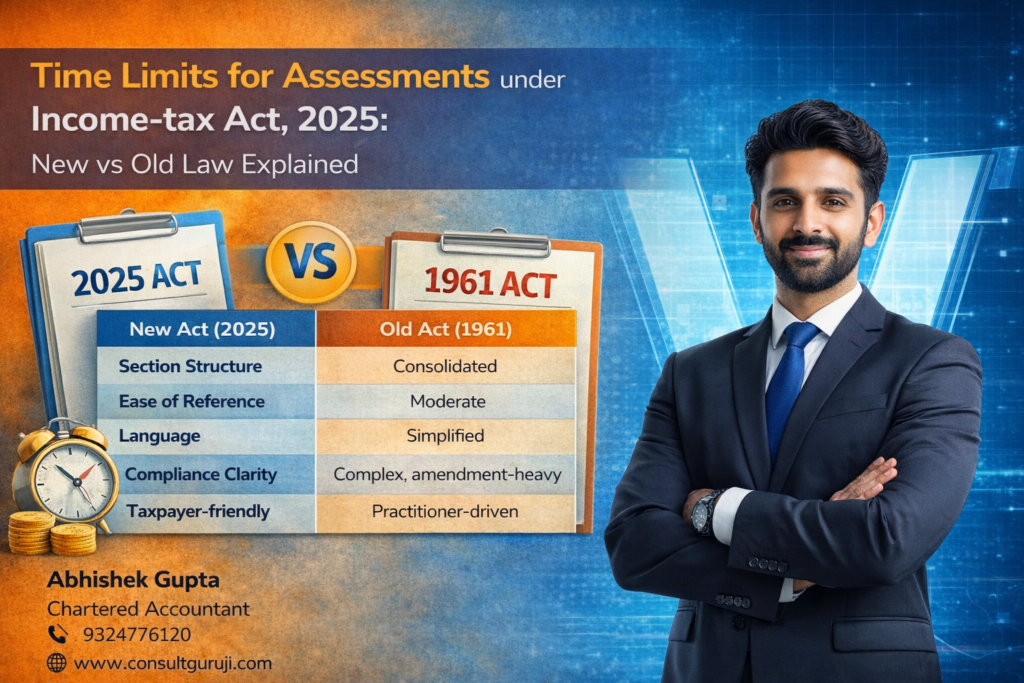
Aspect Income-tax Act, 1961 Income-tax Act, 2025
Structure Scattered sections Consolidated & systematic
Language Technical & complex Simple & precise
Discretion High Rationalised
Litigation risk High Reduced
Compliance focus Punitive Compliance-oriented
Impact on Taxpayers and Professionals
Better clarity on consequences of defaults
Easier compliance planning
Fewer interpretational disputes
Predictable penalty exposure
For professionals, the new structure improves advisory quality and litigation management.
Conclusion
The penalty provisions under the Income-tax Act, 2025 represent a major step towards rational tax administration. By reorganising old sections and simplifying enforcement, the new law aims to encourage voluntary compliance while maintaining deterrence against non-compliance.
Understanding this transition is essential for taxpayers, businesses, and tax professionals alike.
Written by:
Abhishek Gupta
Chartered Accountant
Office No. 19, Sagar Building, 4th Floor, Plot-327,
Narshi Natha Street, Masjid Bunder (West),
Mumbai – 400009
📞 9324776120
🌐 www.consultguruji.com