


Faceless Assessment Framework under Income-tax Act, 2025

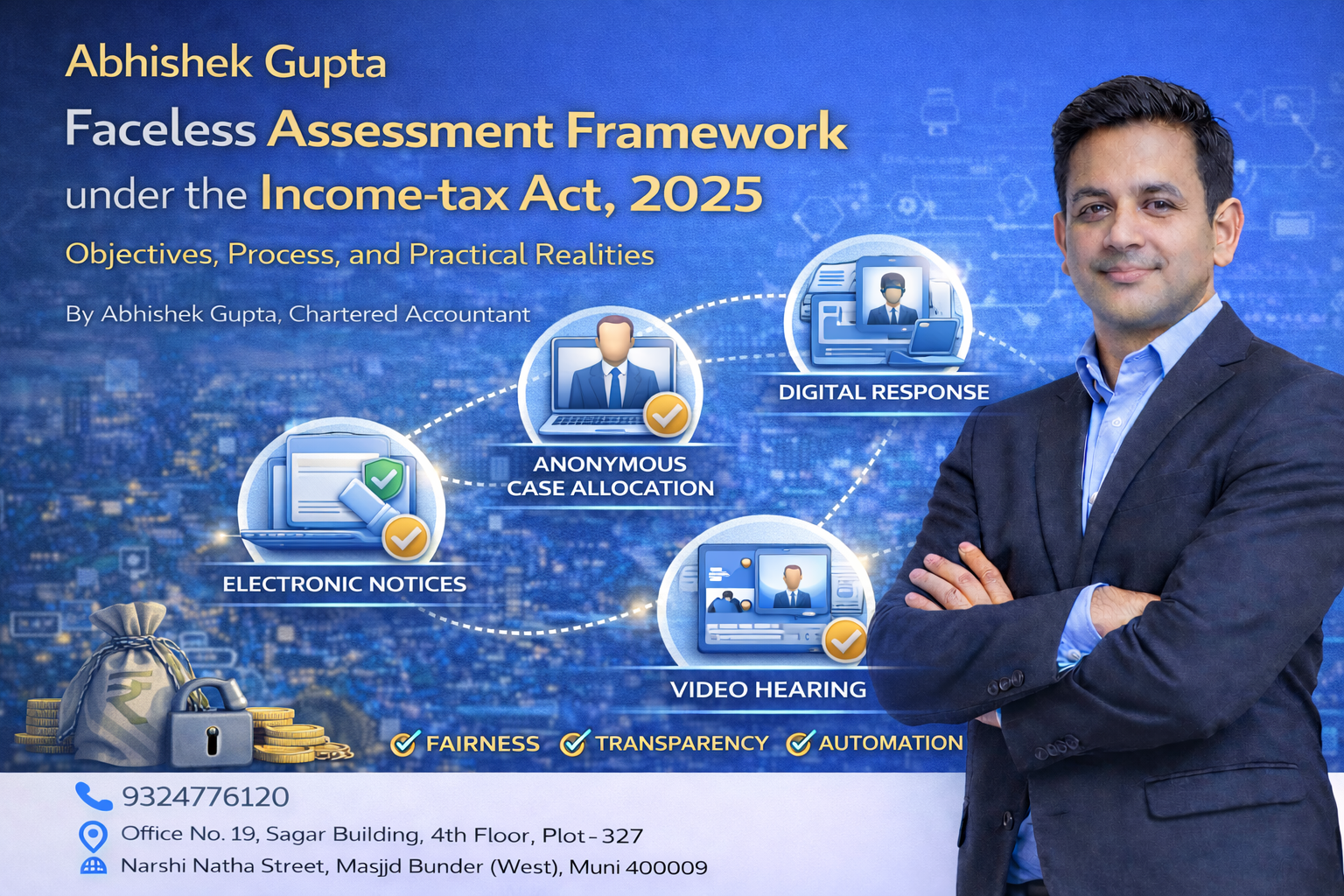
The Faceless Assessment Framework represents a fundamental shift in India’s tax administration. Under the Income-tax Act, 2025, faceless assessment is no longer an experiment. It is the default mode of scrutiny, designed to eliminate discretion, reduce personal interface, and bring consistency in assessments.
However, while the framework is technology-driven, its success ultimately depends on how well taxpayers understand and respond within this system.
Objective of Faceless Assessment
The core objectives of faceless assessment are:
Elimination of physical interaction between taxpayer and Assessing Officer
Reduction of corruption and discretion
Standardisation of assessment procedures
Transparent and accountable decision-making
The intent is to shift tax administration from officer-centric to system-centric.
How the Faceless Assessment Framework Works
Under the framework:
Cases are assigned electronically to assessment units
Notices, replies, and orders are exchanged only through the portal
Personal hearing, if required, is conducted via video conferencing
Different units handle verification, technical review, and finalisation
No single officer controls the entire assessment process.
Key Features of Faceless Assessment
Important features include:
Automated case allocation
Anonymous interaction
Time-bound responses
Mandatory electronic communication
Review mechanism before final order
These features aim to improve quality while reducing arbitrariness.
Role of the Taxpayer
Faceless assessment places greater responsibility on taxpayers.
Key expectations include:
Timely and complete replies
Proper documentation
Clear explanations in writing
Strict adherence to deadlines
Accurate data consistency with AIS, TIS, and returns
There is no scope for oral persuasion. Your written reply is your only defence.
Challenges in Faceless Assessment
Despite its objectives, faceless assessment has practical challenges:
Mechanical or template-based additions
Misunderstanding of business realities
Limited opportunity to explain complex facts
Technical glitches and communication gaps
Courts have repeatedly held that principles of natural justice must still be followed, even in faceless mode.
Safeguards and Taxpayer Rights
Under the Income-tax Act, 2025, taxpayers retain:
Right to seek personal hearing via video conference
Right to adequate opportunity of being heard
Right to reasoned and speaking orders
Right to appeal against faceless assessment orders
Faceless does not mean right-less.
Impact on Litigation
In the long run, faceless assessment is expected to:
Reduce officer-level disputes
Improve consistency of orders
Shift litigation focus to legal interpretation rather than conduct
However, improper implementation can increase first-appeal litigation.
Conclusion
The Faceless Assessment Framework under the Income-tax Act, 2025 is a structural reform, not merely a procedural change.
For taxpayers, success in faceless assessment depends on:
Precision
Documentation
Timely digital compliance
The assessment may be faceless, but the consequences are very real.
Understand the system, or the system will decide for you.