


Estimated Additions Alone Not Enough for Penalty, Rules ITAT

Tribunal Deletes Penalty Where Profit Element of Alleged Bogus Purchases Was Estimated
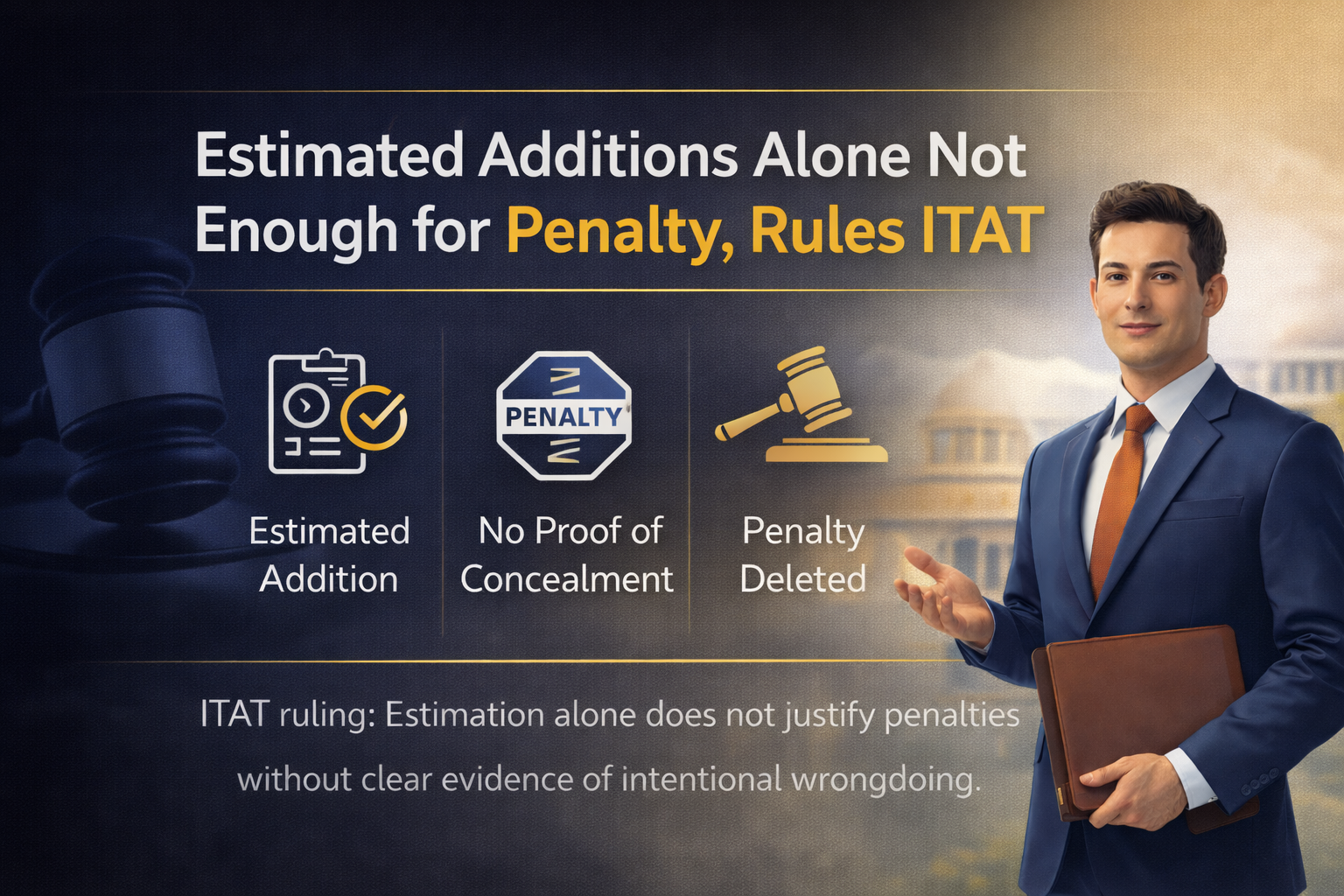
In a significant ruling, the Income Tax Appellate Tribunal held that penalty cannot be levied merely because an addition was made on an estimated basis. The Tribunal observed that when the Assessing Officer adds only the profit element of alleged bogus purchases, such estimation by itself does not automatically justify penalty proceedings.
Let’s understand what happened.
Background of the Case
During assessment, the Assessing Officer treated certain purchases as non-genuine based on information received from external sources. However, instead of disallowing the entire purchase amount, the officer estimated a percentage of profit embedded in those purchases and added that amount to the income of the assessee.
In simple terms, the addition was not based on concrete evidence of concealed income but on an estimation of profit.
Subsequently, penalty proceedings were initiated alleging concealment of income and furnishing of inaccurate particulars.
Tribunal’s Key Observations
The ITAT examined whether penalty can be sustained when the quantum addition itself is based purely on estimation.
The Tribunal noted:
The addition was made on estimated profit percentage.
There was no direct evidence proving actual concealment.
The assessee had recorded purchases in books of accounts.
The dispute was primarily about the extent of profit, not the existence of income.
The Tribunal emphasized that estimation of income does not automatically lead to the conclusion that the assessee deliberately concealed income.
Why Penalty Was Deleted
The Tribunal held that:
Penalty proceedings are separate and distinct from assessment proceedings.
When income is determined on estimation, it involves a degree of approximation.
Mere estimation cannot be equated with concealment or furnishing inaccurate particulars.
Accordingly, the penalty was deleted.
Legal Principle Reinforced
This ruling strengthens an important principle in tax litigation:
Addition on estimated basis ≠ Automatic penalty.
Unless there is clear evidence of deliberate concealment or falsification, penalty cannot be sustained merely because an addition has been confirmed on estimation.
Practical Implication for Taxpayers
If your case involves:
Alleged bogus purchases
Addition of only profit element
Income determined on estimation
Then penalty exposure may not automatically arise.
What this really means is simple:
When income is estimated, intention to conceal must still be proved. Estimation alone is not enough.
Summary
In a decisive ruling, the Income Tax Appellate Tribunal held that penalty cannot be imposed merely because an addition is made on an estimated basis. Where the Assessing Officer adds only the profit element of alleged bogus purchases without concrete evidence of concealment, such estimation does not automatically establish deliberate tax evasion.
The Tribunal clarified that assessment and penalty proceedings are separate. An estimated addition may justify tax liability, but it does not, by itself, prove concealment or furnishing of inaccurate particulars. In the absence of clear evidence of intentional wrongdoing, penalty cannot survive.
This ruling reinforces a crucial principle in tax jurisprudence: estimation of income is not equivalent to concealment.
Also Read
Gujarat High Court Declines to Excuse Prolonged Delay, Emphasizes Duty of Litigants to Monitor Their Cases
New Income Tax Act 2025: HRA on Rent Paid to Relatives – What Salaried Taxpayers Must Now Disclose