


Gujarat High Court Declines to Excuse Prolonged Delay, Emphasizes Duty of Litigants to Monitor Their Cases

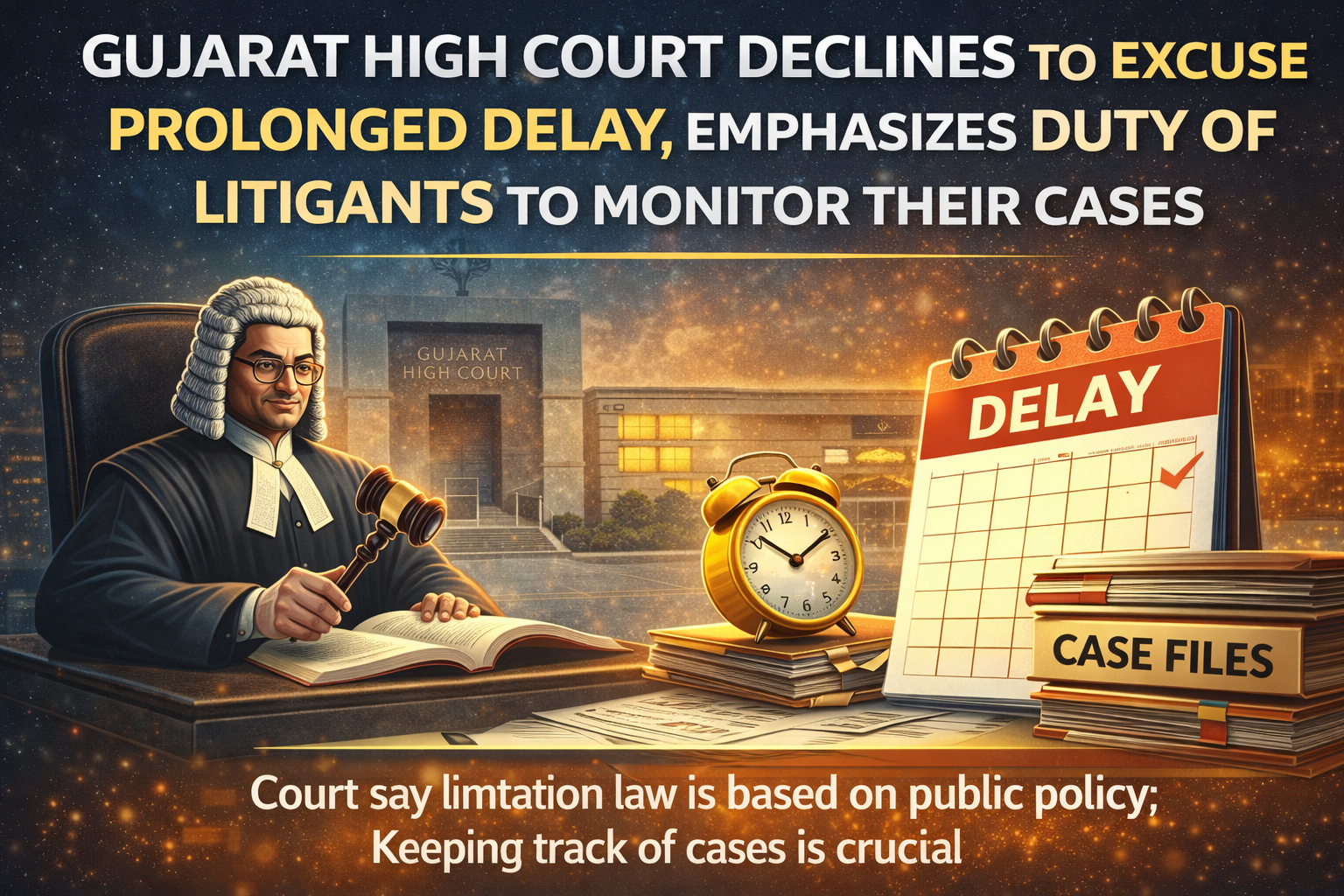
Gujarat High Court Declines to Excuse Prolonged Delay, Emphasizes Duty of Litigants to Monitor Their Cases
In a significant ruling, the Gujarat High Court refused to condone a prolonged delay in filing proceedings and underscored that litigants must actively monitor their cases rather than remain passive spectators.
The Court made it clear that while judicial discretion exists to condone delay in genuine cases, such discretion cannot be exercised mechanically, especially where negligence is evident.
Background of the Case
The petitioner approached the High Court seeking condonation of an inordinate delay in filing an appeal/petition. The delay ran into several years, and the explanation offered was largely based on lack of communication from counsel and alleged unawareness of the status of the case.
The respondent opposed the plea, arguing that the delay was gross, unexplained, and reflective of complete inaction on the part of the litigant.
Key Issue Before the Court
Whether such a prolonged delay can be condoned merely on the ground that the litigant was not properly informed by their advocate, and whether sufficient cause was shown under the law governing limitation.
Court’s Observations
The Gujarat High Court observed:
-
Law of limitation is founded on public policy and cannot be diluted casually.
-
A litigant cannot completely shift responsibility onto their advocate.
-
Parties are expected to exercise due diligence and remain vigilant about the progress of their cases.
-
Condonation of delay is a discretionary relief, not a matter of right.
The Court emphasized that though courts adopt a liberal approach in certain cases, such liberality cannot extend to situations involving gross negligence or prolonged inaction.
Final Ruling
The High Court declined to condone the prolonged delay and dismissed the petition, holding that no sufficient cause had been established to justify such extraordinary delay.
Legal Significance
This ruling reinforces an important principle:
-
Limitation laws are not procedural technicalities; they ensure certainty and finality.
-
Litigants must take active interest in their legal proceedings.
-
Mere blame on counsel without proof of diligence is insufficient.
The judgment serves as a reminder that the justice system protects the vigilant, not the indifferent.
Practical Takeaway
If you are involved in litigation:
-
Regularly follow up with your advocate
-
Keep records of communications
-
Track case status through online court portals
-
Act promptly when adverse orders are passed
Courts may show leniency in genuine hardship cases, but prolonged silence and inaction can close the doors of remedy.
One thought on “Gujarat High Court Declines to Excuse Prolonged Delay, Emphasizes Duty of Litigants to Monitor Their Cases”
Comments are closed.