

High Court Rules ITC Cannot Be Blocked for Genuine Buyer Due to Supplier’s Tax Lapse

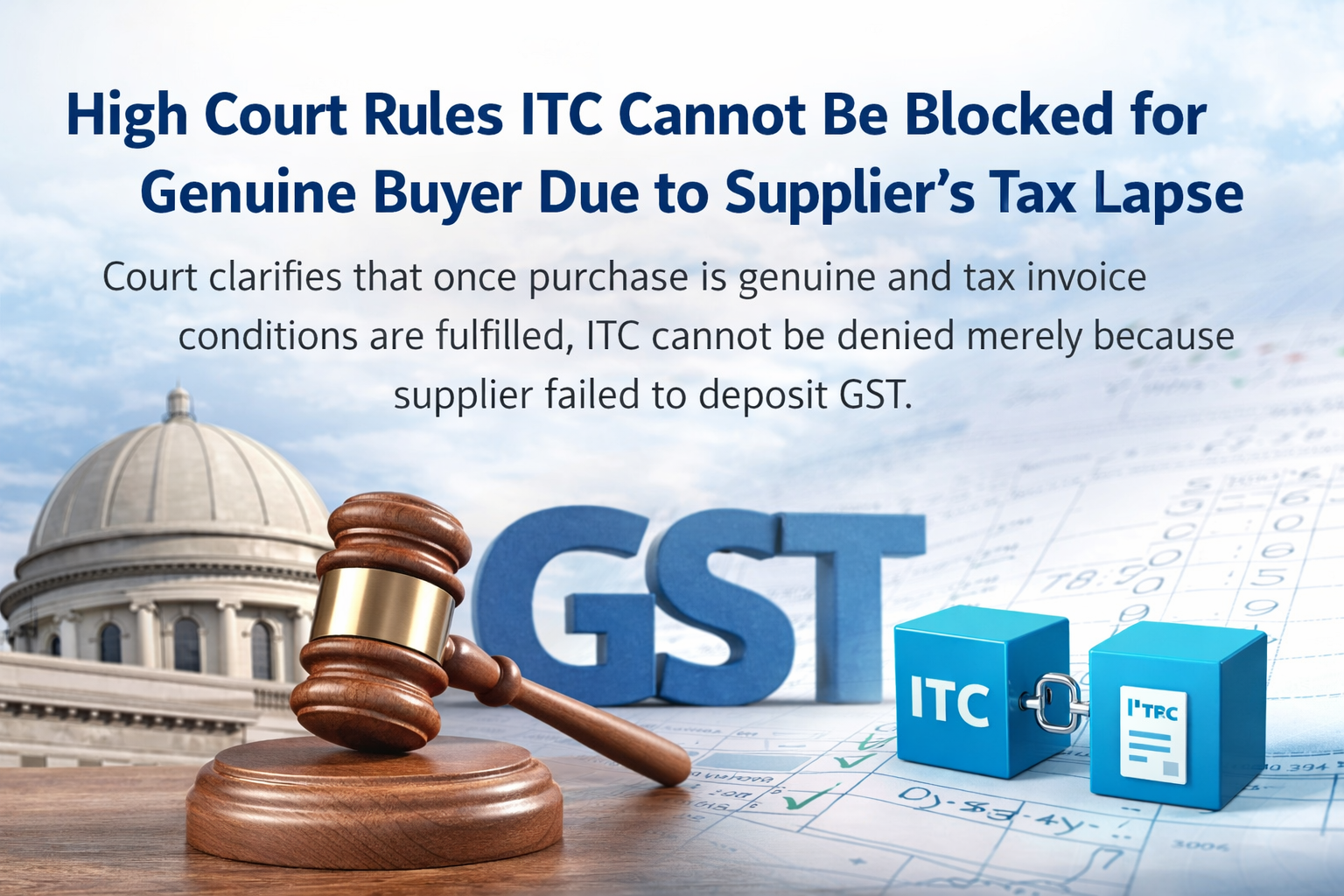
High Court Rules ITC Cannot Be Blocked for Genuine Buyer Due to Supplier’s Tax Lapse
1. Background of the Case
The petitioner (buyer) had purchased goods/services from a registered supplier.
All conditions such as:
-
Valid tax invoice
-
GST charged on invoice
-
Goods/services actually received
-
Payment made through banking channel
were properly fulfilled.
However, during departmental verification, it was found that the supplier had not deposited the GST collected from the buyer with the Government.
Based on this, the department denied Input Tax Credit (ITC) to the buyer under Section 16(2)(c) of the CGST Act.
2. Issue Before the Court
Whether ITC can be denied to a bona fide purchaser merely because the supplier failed to deposit GST with the Government?
In simple words:
Is the buyer responsible for the tax default committed by the seller?
3. Relevant Legal Provision
Section 16(2)(c) of the CGST Act states that ITC is available only if the tax charged on supply has been actually paid to the Government.
The department interpreted this strictly and argued that since tax was not deposited by the supplier, ITC must be reversed.
4. Court’s Observations
The High Court examined the intention behind Section 16(2)(c) and made key observations:
-
A genuine buyer cannot be penalized for the fault of the seller.
-
The buyer has no mechanism or control to verify whether the supplier has actually deposited GST.
-
Once the buyer has fulfilled all statutory conditions and acted in good faith, ITC cannot be denied automatically.
-
Denial of ITC without establishing collusion, fraud, or knowledge of default is arbitrary.
The Court emphasized that GST law does not intend to punish honest taxpayers.
5. Important Principle Laid Down
ITC cannot be denied merely on the ground that the supplier failed to deposit tax, unless:
-
The transaction is fake or bogus
-
There is collusion between buyer and seller
-
The buyer was aware of the fraud
Burden cannot be shifted entirely on the purchaser.
6. Final Decision
The High Court allowed the petition and directed the department:
-
Not to deny ITC to the genuine buyer
-
To take recovery action against the defaulting supplier instead
The Court protected the bona fide purchaser.
7. Practical Impact for Taxpayers
What this really means is:
-
Genuine businesses are protected.
-
ITC cannot be blocked blindly due to supplier’s GST default.
-
Department must prove involvement of the buyer before reversal.
-
Recovery should be made from the actual defaulter.
8. Key Takeaway
GST compliance responsibility cannot be extended beyond reasonable limits.
A buyer who has acted honestly, maintained proper documentation, and complied with law cannot be punished for someone else’s tax default.