


Kerala High Court Rules GST Intelligence Officers Cannot Decide Their Own Show Cause Notices

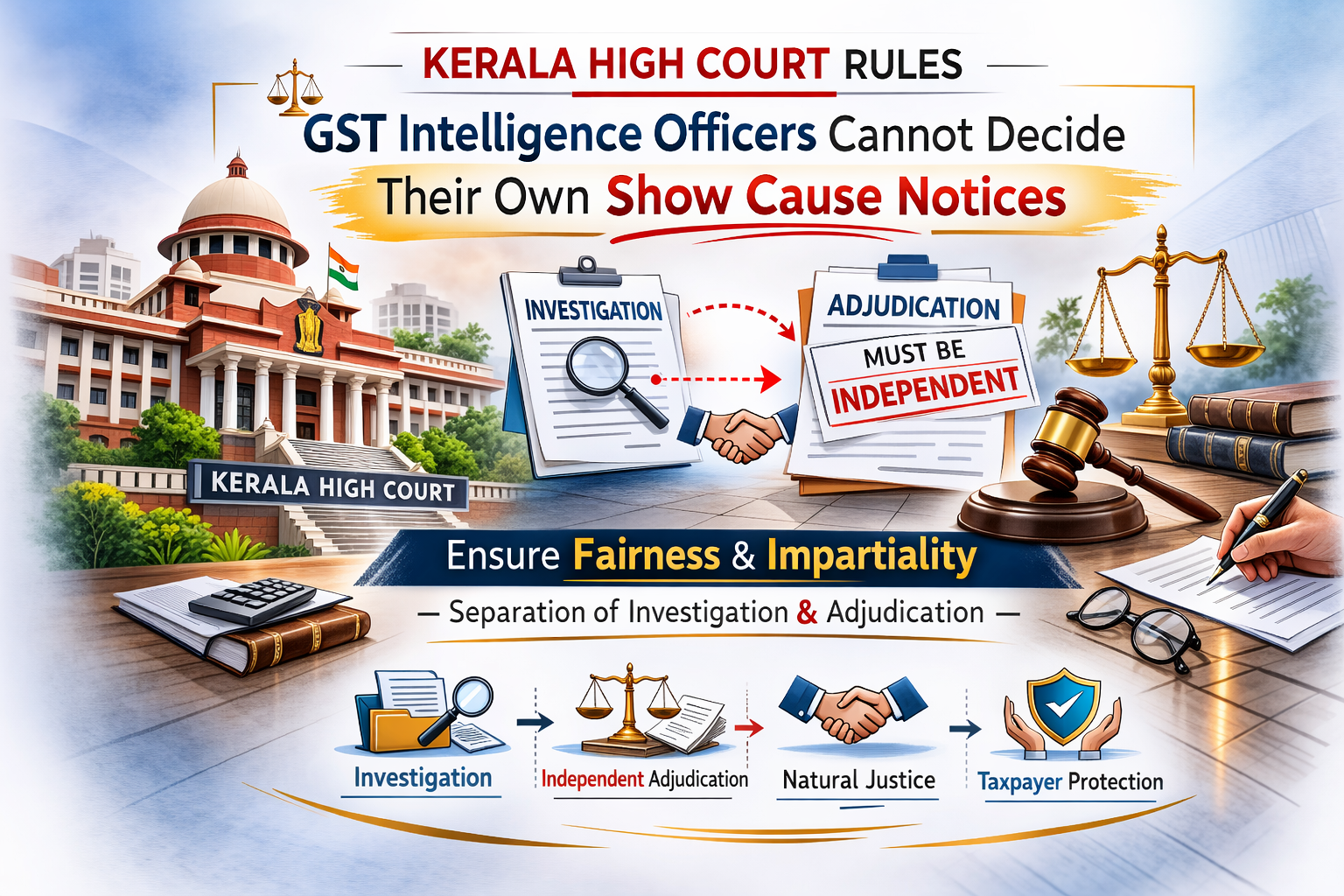
Kerala High Court Rules GST Intelligence Officers Cannot Decide Their Own Show Cause Notices
Court Emphasizes Separation Between Investigation and Adjudication Under GST Law
In a significant ruling, the Kerala High Court held that officers of the GST Intelligence Wing who issue show cause notices cannot adjudicate those very notices themselves. The Court observed that such a practice undermines the principles of natural justice and creates a serious risk of bias.
The judgment reinforces the fundamental rule that no person should be a judge in their own cause.
Background of the Case
The matter arose where GST Intelligence officers conducted investigation proceedings and subsequently issued show cause notices alleging tax irregularities. However, the same officers proceeded to adjudicate the notices and pass orders.
The petitioner challenged this process, arguing that investigation and adjudication by the same authority violates fairness and impartiality.
Key Observations of the High Court
The Kerala High Court made the following important observations:
Adjudication must be independent and unbiased.
An officer who initiates proceedings should not act as the adjudicating authority in the same matter.
Combining investigative and adjudicatory roles raises legitimate apprehension of bias.
The GST framework must be implemented in a manner consistent with principles of natural justice.
The Court emphasized that even if the statute does not explicitly prohibit such action, constitutional principles of fairness must prevail.
Principle of Natural Justice Reaffirmed
The judgment strongly reiterates the doctrine of:
Nemo judex in causa sua — no one should be a judge in their own case.
By separating the investigative function from adjudication, the Court ensured procedural fairness and protected taxpayers from potential misuse of authority.
Practical Impact
This ruling has major implications for GST litigation:
Intelligence officers may continue to investigate and issue notices.
However, adjudication must be conducted by a proper jurisdictional authority independent of the investigation.
Orders passed in violation of this principle may be subject to challenge.
For taxpayers facing proceedings initiated by GST Intelligence Wings, this judgment provides a strong ground to question jurisdiction if the same officer adjudicates the matter.
Key Takeaway
The Kerala High Court has drawn a clear line: investigation and adjudication cannot merge into one authority when it compromises impartiality.
What this really means is simple — fairness in tax administration is not optional; it is mandatory.
Summary
In a landmark ruling, the Kerala High Court held that GST Intelligence officers who issue show cause notices cannot adjudicate those very proceedings. The Court observed that allowing the same authority to investigate and decide the matter violates core principles of natural justice and creates a reasonable apprehension of bias.
Reaffirming the doctrine that no one can be a judge in their own cause, the Court directed that adjudication must be carried out by an independent jurisdictional authority. The judgment sends a clear message: procedural fairness in tax administration is non-negotiable.
This decision significantly strengthens taxpayer protection against biased adjudication under GST law.
ALSO READ
ITAT: Cash Gifts Taxable, Credit Card and Agricultural Land Additions Deleted
Summary
In a recent decision, the Income Tax Appellate Tribunal partly upheld the additions made by the Assessing Officer for AY 2021–22. The Tribunal sustained the addition in respect of cash gifts, holding that the assessee failed to properly establish the identity, creditworthiness, and genuineness of the donors. Since the transactions were in cash and not backed by strong documentary evidence, the addition was confirmed.
However, the Tribunal granted relief on other issues. The addition made towards credit card expenses was deleted after it was shown that the payments were routed through disclosed bank accounts and supported by financial records. Similarly, the addition relating to sale of agricultural land was removed after examining the nature and location of the land and confirming that it qualified as agricultural land under the Income-tax Act.
The ruling highlights an important principle: cash transactions demand strict proof, while properly documented transactions reflected in books cannot be taxed merely on suspicion.

One thought on “Kerala High Court Rules GST Intelligence Officers Cannot Decide Their Own Show Cause Notices”
Comments are closed.