


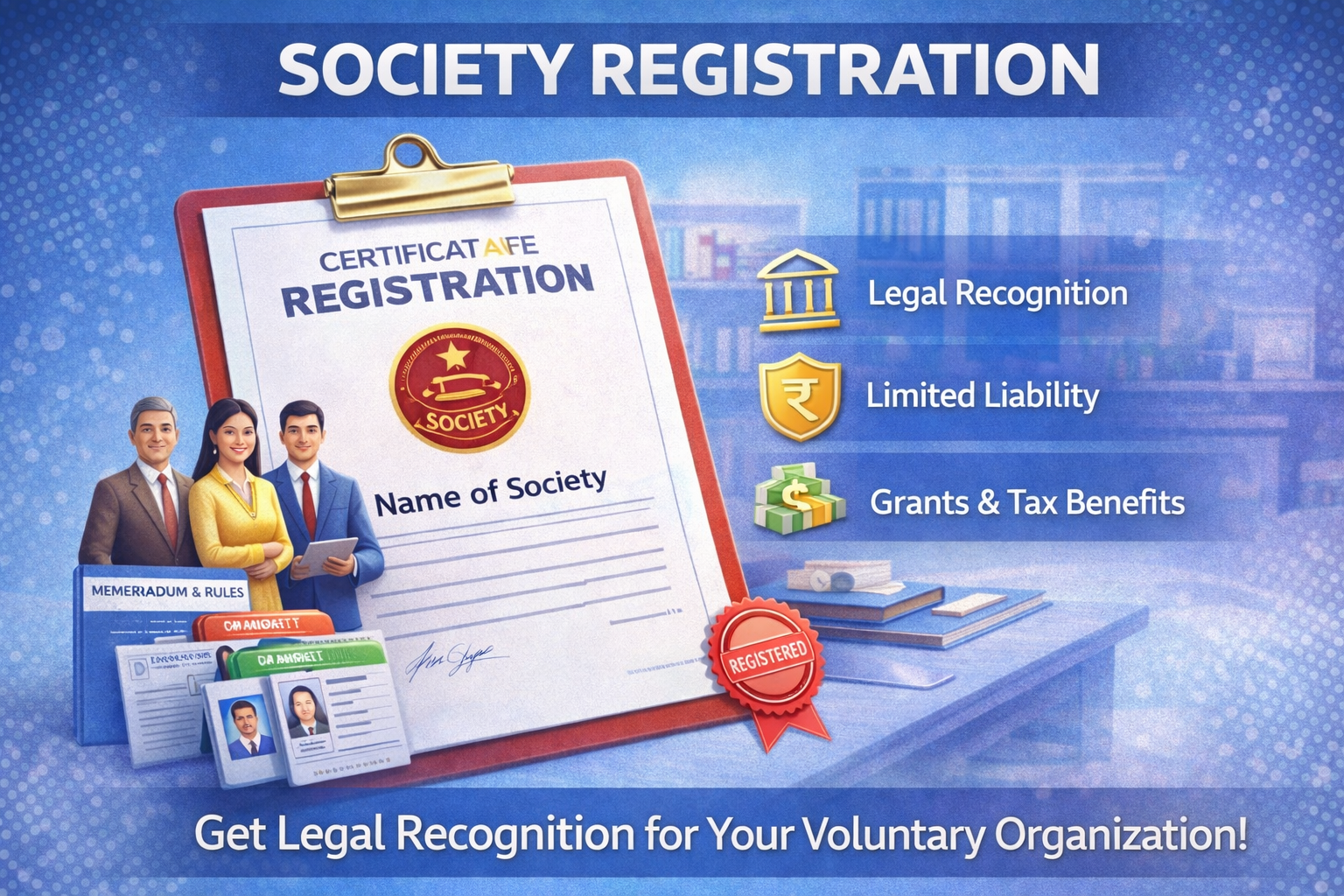
Key Components of Society Registration:
Preparation:
Selection of Name:
Choose a unique name for the society that does not resemble any existing registered society. The name should reflect the objectives of the organization.
Minimum Members:
A minimum of 7 members (for state level) is required to form a society. Members typically include President, Secretary, Treasurer, and other governing body members.
Drafting of Documents:
Prepare the following essential documents:
-
Memorandum of Association (MOA)
-
Rules & Regulations of the Society
-
ID & Address Proof of all members
-
Registered Office Address Proof
-
Affidavits & Declarations (as per state requirements)
Registration Process:
Document Submission:
Submit the required documents along with the prescribed government fee to the Registrar of Societies of the respective state.
Verification:
The Registrar verifies the documents, member details, and objectives of the society.
Approval:
Upon successful verification, the Registrar issues a Certificate of Registration confirming legal existence of the society.
Post-Registration Compliance:
PAN Application:
Apply for Permanent Account Number (PAN) in the name of the society.
Bank Account Opening:
Open a bank account in the society’s name for financial transactions.
Annual Compliance:
Maintain proper books of accounts, conduct annual meetings, and file required annual returns with the Registrar.
Tax Registration (If Applicable):
Apply for 12A & 80G registration (for tax exemption) and other registrations if required.
Fee Structure:
Government Fees:
Nominal registration fees payable to the Registrar of Societies (varies by state).
Professional Fees:
Consultancy and documentation preparation charges.
Benefits of Society Registration:
Legal Recognition:
Provides legal identity to the organization.
Limited Liability:
Members’ liability is generally limited to their contribution.
Tax Benefits:
Eligible for tax exemptions under Income Tax Act (subject to approval).
Credibility:
Enhances trust among donors, government authorities, and funding agencies.
Eligibility for Grants:
Registered societies can apply for government grants and CSR funding.
Challenges:
Regulatory Compliance:
Regular filing of annual returns and maintaining records is mandatory.
State-Specific Rules:
Registration process and documentation vary from state to state.
Limited Profit Distribution:
Societies are formed for charitable or non-profit purposes and cannot distribute profits among members.
Conclusion:
Society Registration is an ideal structure for NGOs, charitable organizations, educational institutions, cultural associations, and welfare groups. It provides legal recognition, credibility, and eligibility for grants and tax benefits. With proper documentation and compliance, a registered society can operate effectively and achieve its social objectives.