


Treatment of Pending Assessments Initiated under 1961 Act

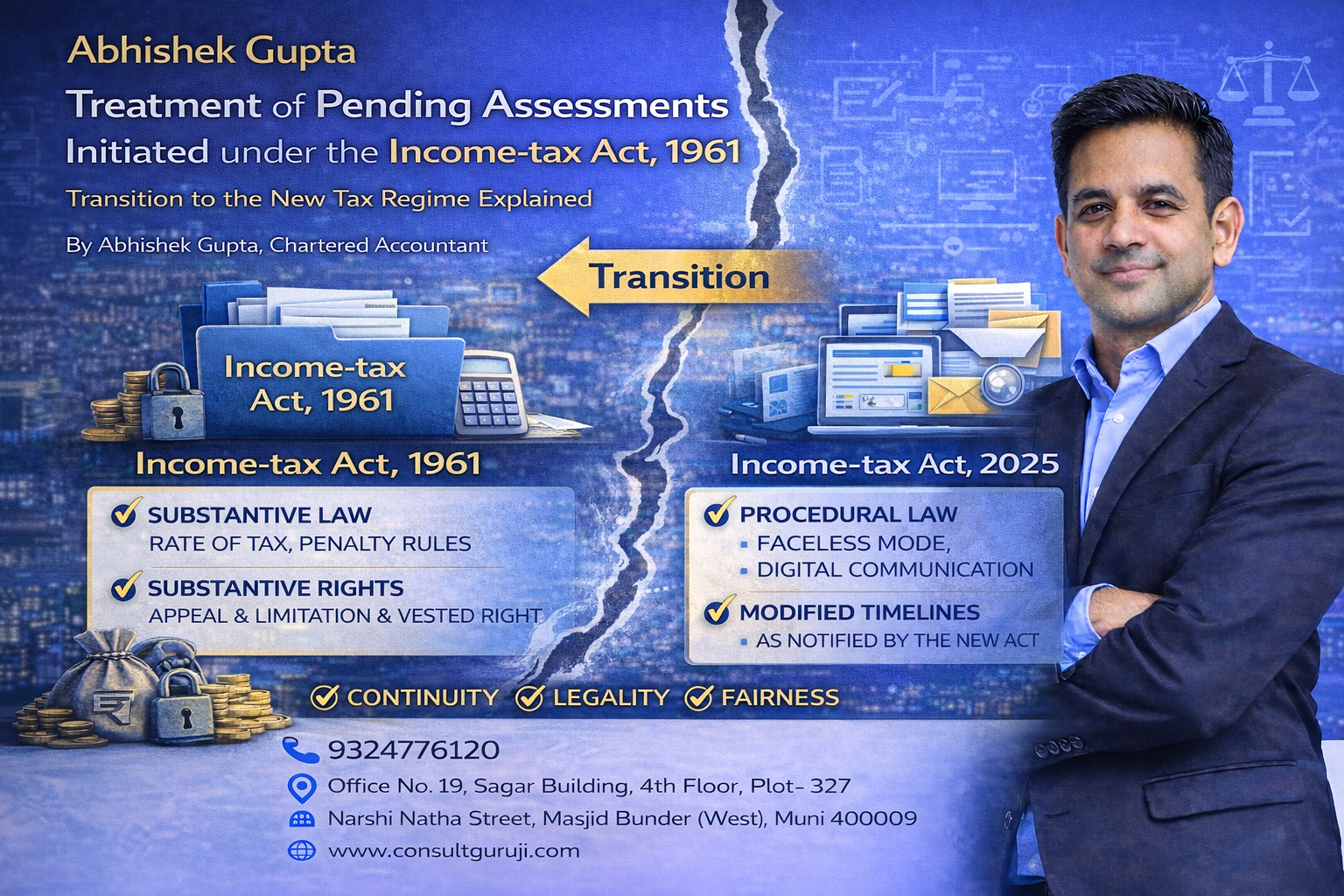
With the enactment of the new Income-tax Act, a key transitional issue arises: what happens to assessments that were initiated under the Income-tax Act, 1961 but remain pending?
The law does not permit such proceedings to vanish or restart arbitrarily. Instead, it provides a structured mechanism to ensure continuity, legality, and fairness during the transition.
Understanding this treatment is critical for taxpayers facing ongoing scrutiny, reassessment, appeal, or penalty proceedings.
Concept of Pending Assessments
Pending assessments include proceedings that were:
Validly initiated under the Income-tax Act, 1961
Not concluded as on the date the new Act came into force
These may include:
Scrutiny assessments
Reassessments
Rectification proceedings
Penalty proceedings
Recovery proceedings
Appeals at various stages
The key factor is initiation under the old law and continuation into the new regime.
Principle of Continuity
The foundational principle governing transition is continuity of proceedings.
Pending proceedings do not abate merely because the governing statute has changed. Instead:
Proceedings continue from the stage at which they were pending
Rights and obligations already crystallised are preserved
Procedural changes may apply prospectively
This ensures legal certainty and prevents administrative chaos.
Applicable Law for Pending Assessments
In general:
Substantive rights and liabilities are governed by the Income-tax Act, 1961
Procedural aspects may be governed by the new Act, where expressly provided
This distinction is crucial.
Substantive provisions include:
Taxability
Rate of tax
Allowability of deductions
Penalty exposure
Procedural provisions include:
Mode of communication
Faceless mechanisms
Digital processes
Timelines where extended or modified
Courts have consistently upheld this separation between substance and procedure.
Impact on Ongoing Scrutiny and Reassessment
For pending scrutiny or reassessment:
Jurisdiction validly assumed under the 1961 Act remains valid
Notices already issued do not become void
Completion must adhere to principles of natural justice
However, assessments must not:
Apply new substantive provisions retrospectively
Enhance liability beyond what old law permitted
Any such action is legally challengeable.
Effect on Pending Appeals and Litigation
Appeals filed under the 1961 Act:
Continue before the same appellate forum
Are decided based on substantive law applicable to the relevant assessment year
Procedural changes, such as faceless appeal mechanisms, may apply if notified and consistent with natural justice.
Right of appeal is a vested right, and cannot be taken away by transition.
Penalty and Prosecution Proceedings
Penalty proceedings initiated under the 1961 Act:
Continue under the same statutory framework
Must apply penalty provisions as they existed for the relevant year
Similarly, prosecution proceedings are governed by:
Law in force at the time of alleged offence
Not by subsequent amendments unless expressly stated
Taxpayer Safeguards during Transition
Taxpayers retain the right to:
Challenge jurisdictional defects
Object to retrospective application of law
Seek benefit of favourable judicial interpretations
Invoke principles of natural justice
Transition cannot be used as a tool to worsen taxpayer position.
Common Areas of Dispute
Disputes typically arise on:
Application of new limitation periods
Use of faceless procedures in old cases
Change in recovery mechanism
Enhancement of penalty exposure
These issues are expected to be litigated and clarified through judicial precedents.
Conclusion
The treatment of pending assessments initiated under the Income-tax Act, 1961 is governed by continuity, legality, and fairness.
The new Income-tax Act does not erase the past. It carries it forward with structure.
For taxpayers, the key is vigilance:
Understand which law applies
Separate substance from procedure
Assert rights where transition is misapplied
A lawful transition preserves confidence in the tax system.
Anything else invites litigation.
Written by:
Abhishek Gupta
Chartered Accountant
Office No. 19, Sagar Building, 4th Floor, Plot-327,
Narshi Natha Street, Masjid Bunder (West),
Mumbai – 400009
📞9324776120
🌐 www.consultguruji.com