


Consequences of non-filing of ROC returns for 2–3 years

Introduction
Many companies ignore ROC compliance for one year thinking it can be managed later.
The real damage starts when ROC returns are not filed for 2–3 consecutive years.
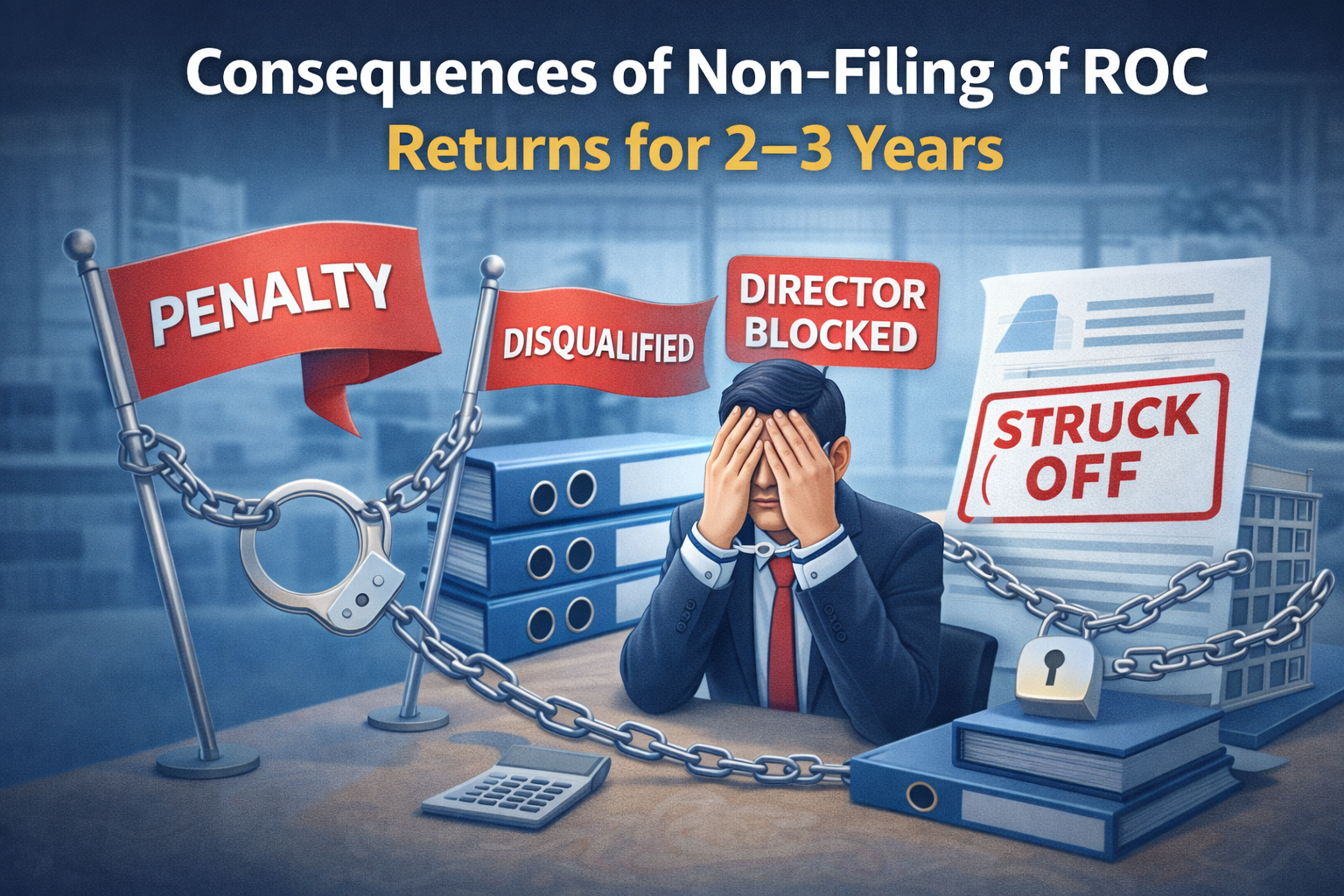
What seems like a small delay turns into penalties, director disqualification, and even company strike-off.
This blog explains what actually happens when ROC returns are ignored for multiple years.
What Is ROC Return Filing
ROC return filing means submitting mandatory annual forms to the Registrar of Companies under the Companies Act, 2013.
These filings update:
Financial position of the company
Shareholding and management details
Legal status of directors
Non-filing breaks this legal reporting chain.
What Happens If ROC Returns Are Not Filed for 2–3 Years
1. Heavy Additional Fees Accumulate
ROC late fees are calculated per day per form.
When returns are not filed for multiple years:
Late fees run into lakhs
There is no maximum cap in many cases
Compliance becomes financially painful
Many companies end up paying more in penalties than professional fees.
2. Director Disqualification for 5 Years
If a company fails to file ROC returns for three continuous financial years, directors become disqualified.
This means:
Directors cannot be appointed in any company
Existing directorships may be vacated
DIN gets flagged on MCA portal
This is one of the most serious consequences.
3. DIN Deactivation and KYC Issues
Non-compliance also affects director records.
Directors may face:
DIN deactivation
Inability to sign filings
Restrictions on future business roles
Once deactivated, revival is time-consuming and stressful.
4. Company May Be Struck Off by ROC
ROC has the power to strike off companies that remain non-compliant for years.
Once struck off:
Company ceases to exist legally
Bank accounts get frozen
Assets become difficult to recover
Revival requires court or tribunal process
Strike-off creates long-term legal complications.
5. Problems in Income Tax, GST, and Banking
Non-compliant ROC status impacts:
GST registrations and amendments
Income Tax scrutiny and assessments
Bank KYC, loans, and account operations
Government departments cross-verify MCA records regularly.
6. No Exit Without Clearing Past Defaults
If a company wants:
Strike-off
Sale
Merger
Director exit
All past ROC non-compliances must be cleared first.
No clean exit is possible without compliance.
Why Companies Ignore ROC Filing (Common Mistakes)
No business activity assumption
Cash flow issues
Lack of professional guidance
Underestimating long-term impact
These mistakes often prove costly.
How to Fix Non-Filing for Past Years
Calculate pending forms and late fees
Prepare corrected financial statements
File returns year-wise in proper sequence
Take professional help to avoid rejection
The earlier you act, the lower the damage.
Conclusion
Ignoring ROC returns for 2–3 years is not a delay.
It is a serious compliance failure with legal and financial consequences.
Regular ROC filing:
Protects directors
Keeps company active
Avoids penalties and litigation
Delay only increases risk.
Call to Action
If your company has missed ROC filings for past years, don’t wait further.
Immediate corrective action can still prevent strike-off and disqualification.
Written by:
Abhishek Gupta
Chartered Accountant
Office No. 19, Sagar Building, 4th Floor, Plot-327,
Narshi Natha Street, Masjid Bunder (West),
Mumbai – 400009
📞9324776120
🌐 www.consultguruji.com