


New Income Tax Act 2025: HRA on Rent Paid to Relatives – What Salaried Taxpayers Must Now Disclose

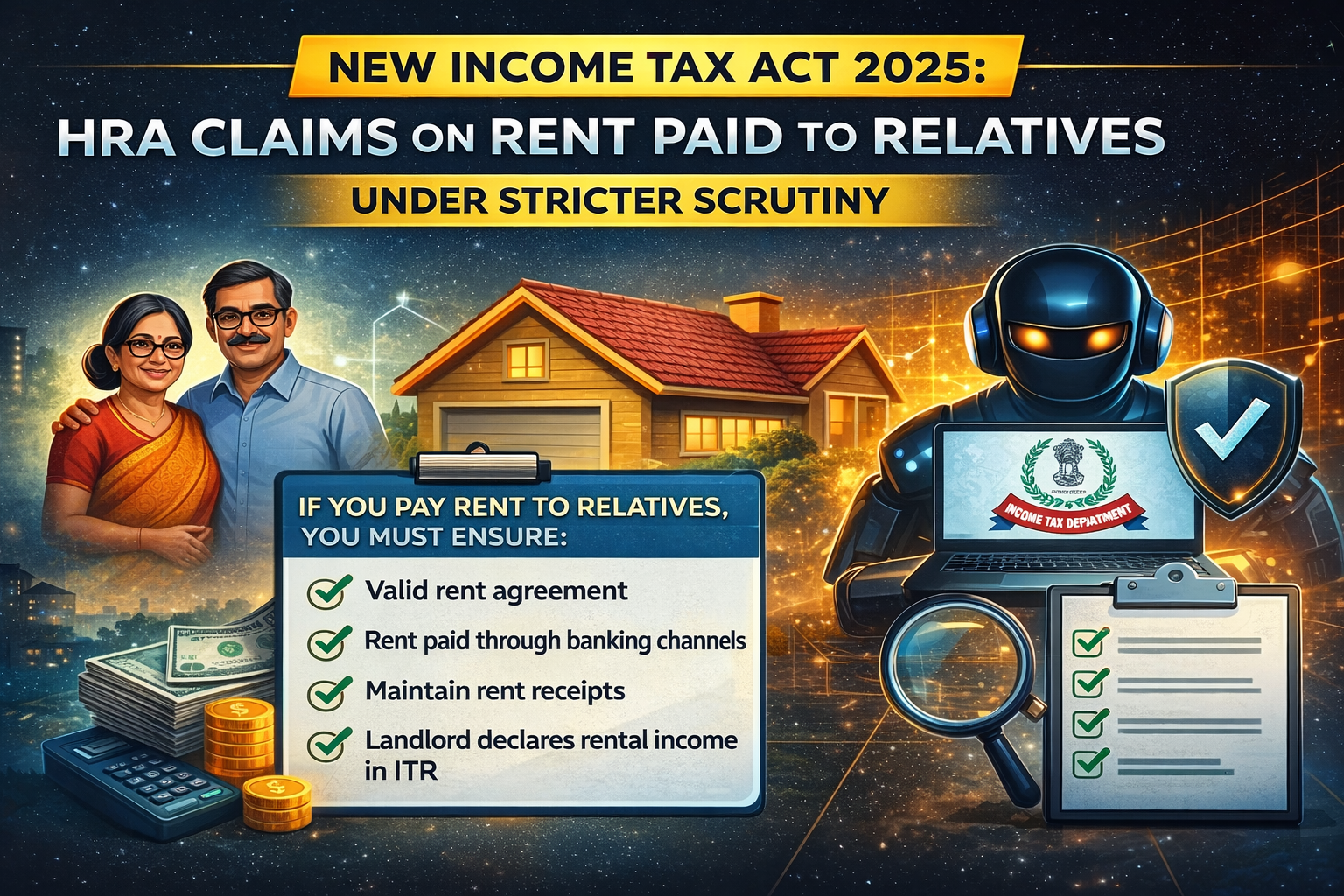
New Income Tax Act 2025: HRA on Rent Paid to Relatives – What Salaried Taxpayers Must Now Disclose
From April 2026, claiming House Rent Allowance on rent paid to parents or other relatives will no longer be a simple declaration exercise. The proposed changes under the New Income Tax Act 2025 tighten disclosure norms and aim to curb misuse of HRA benefits.
Let’s break this down clearly.
What Is Changing?
If a salaried individual pays rent to a relative and claims HRA exemption, they will now be required to:
-
Explicitly disclose the relationship with the landlord
-
Provide proper documentation supporting the rental arrangement
-
Ensure the transaction is genuine and traceable
Earlier, many employees used to pay rent to parents and claim HRA, which is perfectly legal if the arrangement is genuine. The issue was misuse. Some cases involved paper transactions without actual rent movement.
The new rules focus on transparency, not prohibition.
Is Paying Rent to Parents Still Allowed?
Yes. It is still allowed.
You can pay rent to your parents and claim HRA, provided:
-
The house is owned by the parent
-
You actually reside there
-
Rent is actually paid through banking channels
-
A proper rent agreement exists
-
The parent declares rental income in their ITR
What this really means is the department wants substance over form. If it’s genuine, you are safe.
Why Is the Government Tightening the Rule?
There are three major reasons:
-
Fake HRA claims where no actual rent was paid
-
Circular transactions within family to reduce taxable income
-
Data mismatch between employee claims and landlord disclosures
With increased digital reporting and AIS tracking, the department can now match HRA claims with landlord PAN and return filings.
This amendment is about data alignment.
Practical Impact on Salaried Individuals
If you are planning to claim HRA on rent paid to relatives:
-
Execute a proper rent agreement
-
Transfer rent via bank, not cash
-
Keep rent receipts signed
-
Ensure landlord reports rental income
-
Avoid inflated rent amounts
As a Chartered Accountant or tax advisor, this is a good opportunity to educate clients. Many people assume family transactions are informal. Tax law does not think that way.
Risk of Non-Disclosure
Failure to properly disclose relationship or misreporting can lead to:
-
Disallowance of HRA exemption
-
Tax demand with interest
-
Possible penalty for misreporting
With AI-driven scrutiny and pre-filled data systems, mismatches are easier to detect than before.
Final Thought
Paying rent to relatives is not illegal. But claiming HRA casually without documentation is risky now.
From April 2026 onward, compliance quality will matter more than tax planning creativity.
If the transaction is real, document it.
If it is artificial, rethink it.
That’s the difference between smart tax planning and unnecessary litigation.
Summary
From April 2026, claiming HRA on rent paid to parents or other relatives will come under sharper scrutiny. The New Income Tax Act 2025 does not ban such claims, but it makes disclosure of the relationship with the landlord mandatory and demands proper documentation.
What this really means is simple: only genuine rental arrangements will survive.
If you are paying rent to a relative, you must ensure:
-
A valid rent agreement exists
-
Rent is paid through banking channels
-
Rent receipts are maintained
-
The landlord declares rental income in their ITR
-
The relationship is clearly disclosed
The tax department is tightening rules to prevent fake or paper transactions within families used purely to reduce tax liability. With digital reporting, AIS tracking, and PAN-based matching, mismatches can easily trigger scrutiny.
Bottom line:
HRA on rent paid to relatives is still allowed, but casual or artificial claims can lead to disallowance, tax demand, interest, and penalty.
Substance will now matter more than structure.
ALSO READ
HUF Creation
Conclusion
HUF ek powerful tax planning tool hai.
Lekin:
Sirf naam ke liye banana faydemand nahi
Proper structure aur compliance ke saath banana chahiye
Sahi planning karein to HUF aapki family wealth structure ko strong bana sakta hai.