

Income Tax Act, 2025: Section-wise Mapping with Income-tax Act, 1961 Explained

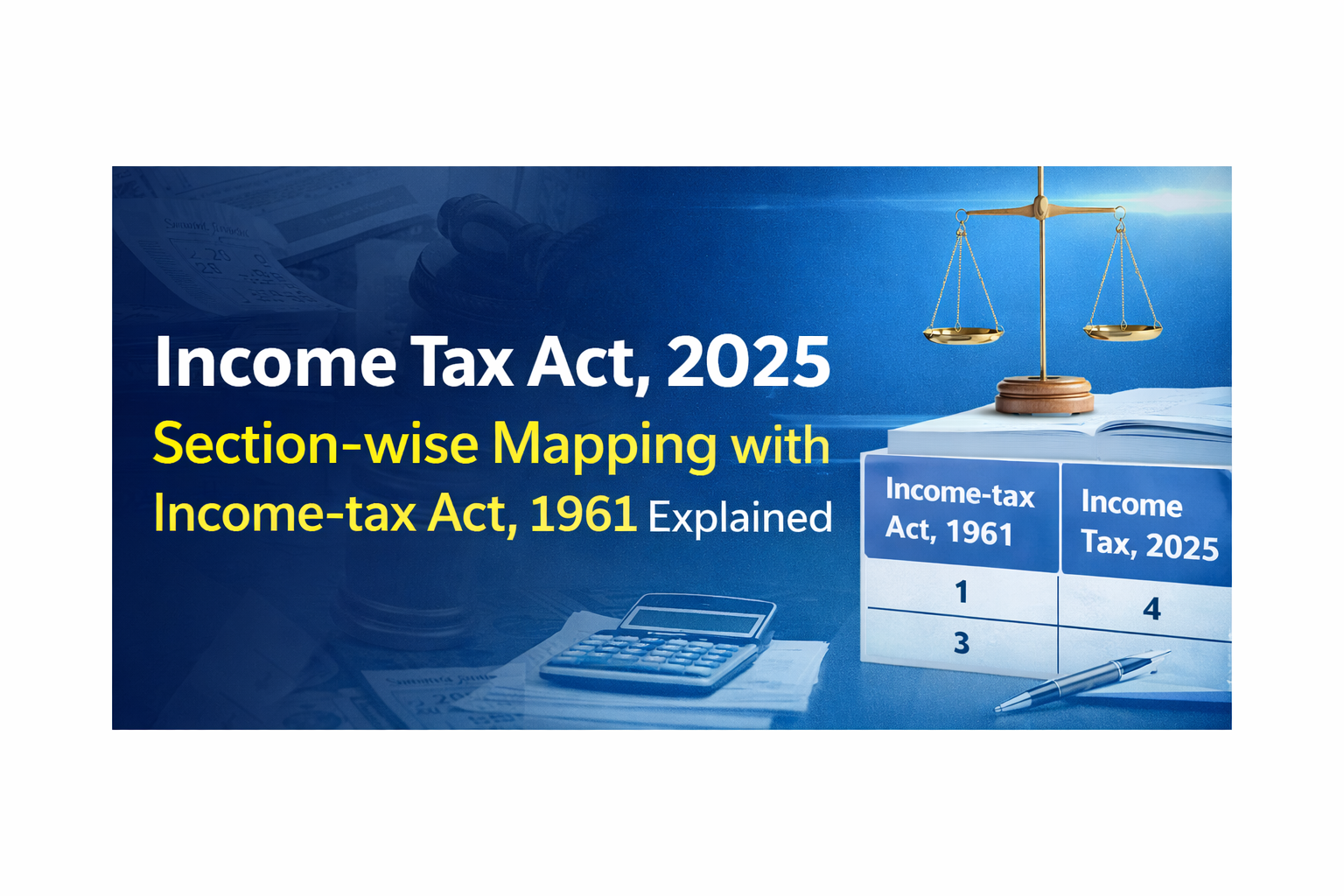
The Government has introduced the Income Tax Act, 2025 with the objective of simplifying India’s direct tax law, removing outdated provisions, and making compliance easier for taxpayers and professionals. One of the most important tools released along with the new Act is the tabular mapping of sections vis-à-vis the Income-tax Act, 1961.
This mapping helps taxpayers, Chartered Accountants, and businesses understand how provisions under the old law correspond to the new framework.
Why a New Income Tax Act Was Needed
The Income-tax Act, 1961 has undergone hundreds of amendments over the decades. While necessary, these changes made the law bulky, complex, and difficult to interpret.
The Income Tax Act, 2025 aims to:
Simplify language and structure
Reorganize sections logically
Remove redundant and obsolete provisions
Improve ease of compliance and administration
Importantly, the new Act focuses on clarity rather than introducing new tax burdens.
What Is Section-wise Tabular Mapping
The tabular mapping provides a side-by-side comparison between:
Sections of the Income-tax Act, 1961, and
Corresponding sections under the Income Tax Act, 2025
This allows professionals to quickly identify:
Where an old section has moved
Whether a section has been renumbered, merged, or split
Whether any provision has been omitted or newly introduced
In simple terms, it acts as a navigation bridge between the old and new law.
Key Benefits of Section Mapping
Smooth Transition
Professionals familiar with the 1961 Act can easily adapt to the 2025 Act without confusion.
Better Compliance
Taxpayers can locate relevant provisions faster, reducing interpretation errors.
Ease in Litigation and Appeals
During assessments or appeals, references to old sections can be accurately linked to the new law.
Time Saving for Professionals
No need to search manually through the entire Act to find equivalent provisions.
Does the New Act Change Tax Rates or Deductions?
The Income Tax Act, 2025 is largely a structural and language overhaul.
In most cases:
Tax rates remain aligned with existing provisions
Core concepts like income heads, deductions, and assessments continue
The focus is on simplification, not disruption
However, professionals should carefully review mapped sections to identify subtle drafting changes that may impact interpretation.
Who Should Study This Mapping Carefully
Chartered Accountants and tax practitioners
Businesses and finance teams
Students of taxation and law
Taxpayers involved in assessments or appeals
Understanding this mapping early will avoid confusion once the new Act is fully operational.
Final Thoughts
The Income Tax Act, 2025 with section-wise mapping to the Income-tax Act, 1961 is a welcome step toward a cleaner and more understandable tax law. While the substance largely remains the same, the structure is far more logical and user-friendly.
Tax professionals should start familiarizing themselves with the new section numbers and layout now to stay ahead and ensure accurate compliance in the coming years.
Written by:
Abhishek Gupta
Chartered Accountant
G Abhishek And Associates
Office No. 19, Sagar Building, 4th Floor, Plot-327,
Narshi Natha Street, Masjid Bunder (West),
Mumbai – 400009
📞9324776120
🌐 www.consultguruji.com