

Time Limits for Assessments under Income-tax Act, 2025: New vs Old Law Explained

Introduction
Time limits for completion of assessment are critical for both taxpayers and tax authorities. The Income-tax Act, 2025 has reorganised and rationalised the assessment timelines that earlier existed under the Income-tax Act, 1961. While the core intent remains the same, the new Act brings clarity, consolidation, and easier reference through revised section numbering.
This article explains how assessment time limits under the new Act compare with the old law.
Assessment Time Limits under the Old Law (Income-tax Act, 1961)
Under the 1961 Act, time limits were scattered across multiple sections such as:
Section 143 / 144 – Regular assessment
Section 147 / 148 – Reassessment
Section 153 – Time limit for completion of assessment
Section 153A / 153C – Search and seizure cases
Key challenges:
Multiple amendments over years
Different timelines for different proceedings
Complex cross-referencing between sections
Assessment Time Limits under the New Law (Income-tax Act, 2025)
The 2025 Act restructures these provisions by:
Grouping all assessment timelines in a logical sequence
Clearly distinguishing between:
Regular assessment
Reassessment
Search-related assessment
Removing redundant provisos and explanations
The new structure makes it easier to identify:
Starting point of limitation
Maximum time available to the Assessing Officer
Special cases where extended timelines apply
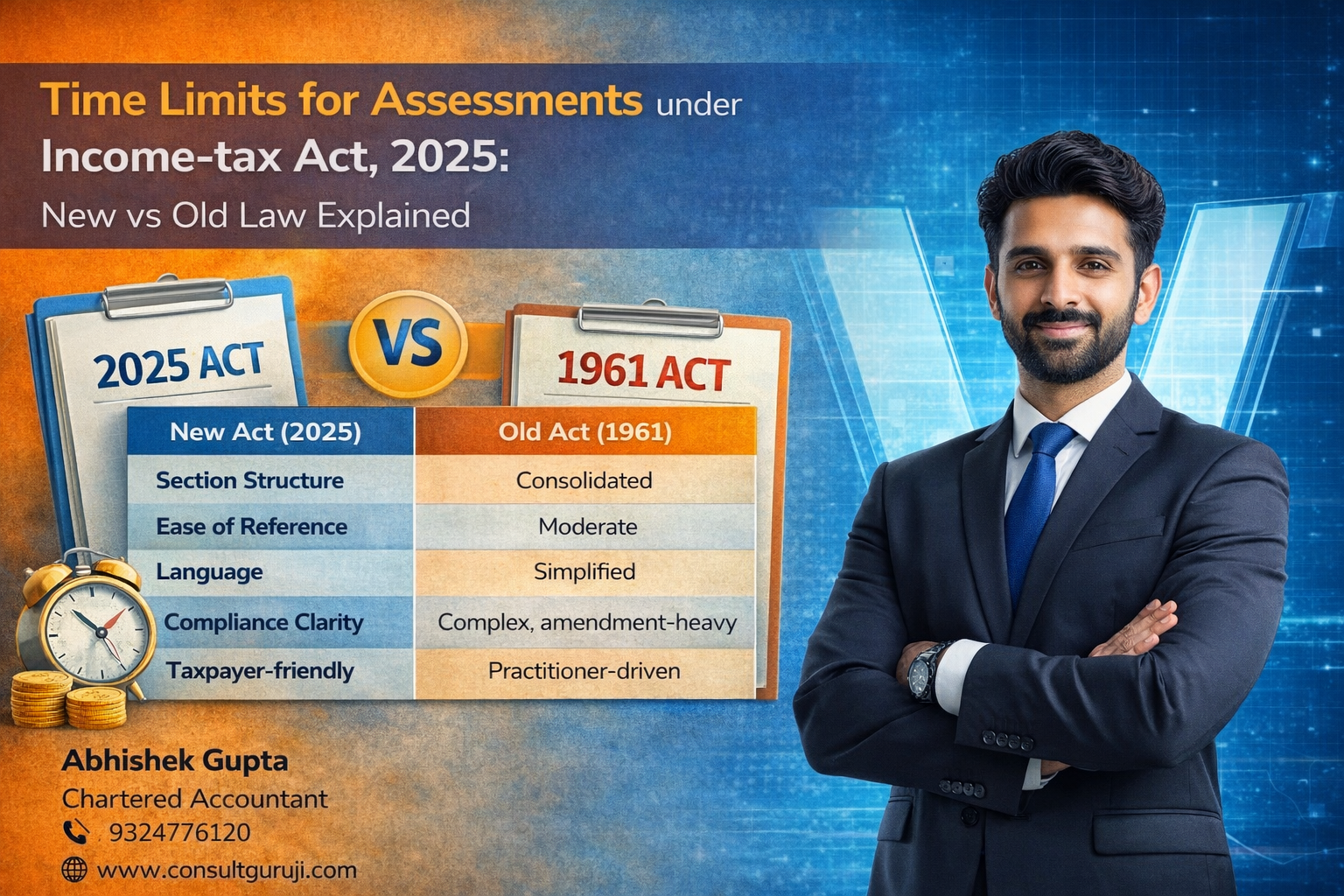
Key Differences: Old vs New Law
Particulars Old Act (1961) New Act (2025)
Section structure Scattered Consolidated
Ease of reference Moderate High
Language Complex, amendment-heavy Simplified
Compliance clarity Practitioner-driven Taxpayer-friendly
What This Means for Taxpayers
Better predictability in assessment closure
Reduced litigation on limitation issues
Easier tracking of assessment deadlines
Improved transparency in tax administration
Conclusion
The Income-tax Act, 2025 does not drastically change assessment timelines but significantly improves their presentation and accessibility. By reorganising the law, it reduces ambiguity and enhances compliance efficiency for both taxpayers and professionals.
Understanding these timelines is essential to safeguard your rights and ensure timely responses during assessment proceedings.
Written by:
Abhishek Gupta
Chartered Accountant
Office No. 19, Sagar Building, 4th Floor, Plot-327,
Narshi Natha Street, Masjid Bunder (West),
Mumbai – 400009
📞 9324776120
🌐 www.consultguruji.com